

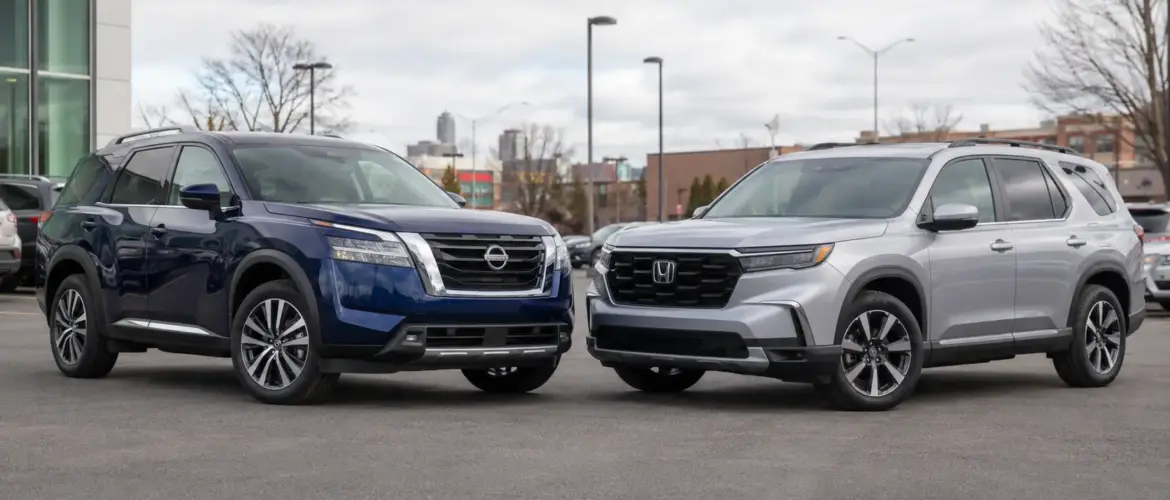
3-Row SUV Showdown
Here’s the fastest way to decide: boat or hockey bags — pick one. The Pathfinder tows up to 6,000 lbs, a full 1,000 lbs more than the Pilot’s 5,000-lb max, and it starts $405 cheaper. The Pilot answers with 33 more cubic feet of maximum cargo room (113.7 vs. 80.5 cu ft) and a third row owners consistently say fits adults better. Both are V6-powered, family-hauler SUVs built for the same Chicago job — Lake Michigan boat launches, ski weekends in Wisconsin, the daily carpool through a real Midwest winter — but they trade off in opposite directions to get there.
This guide breaks down price, towing, cargo, safety, and total cost of ownership so you can see which one actually fits your driveway in Skokie, Glenview, or anywhere on the North Shore.
Quick Comparison at a Glance
Both towing numbers carry a real asterisk — see Engine, Performance and Towing below before you assume either max figure applies to your trim.
| Category | Nissan Pathfinder | Honda Pilot |
|---|---|---|
| Starting MSRP | $41,990 (SV, 4WD) | $42,395 (Sport, FWD) |
| Engine | 3.5L V6, 284 hp (295 hp Rock Creek) | 3.5L V6, 285 hp / 262 lb-ft |
| Transmission | 9-speed automatic (all trims) | 10-speed automatic (all trims) |
| Drivetrain | 4WD, standard on every trim | FWD standard (Sport/EX-L), AWD standard on TrailSport and up |
| Fuel economy (EPA est.) | Up to 21 city / 26 hwy | Up to 19 city / 27 hwy (FWD) |
| Seating | 8-passenger standard; 7-pass. captain’s chairs available | 8-passenger standard; 7-pass. on TrailSport |
| Cargo (behind 3rd row) | 16.6 cu ft | 18.6 cu ft |
| Max cargo (seats folded) | 80.5 cu ft | 113.7 cu ft |
| Max towing | Up to 6,000 lbs* | Up to 5,000 lbs (AWD only)* |
| Touchscreen | 12.3″ standard, every trim | 12.3″ standard, every trim |
| Instrument cluster | 7″ (SV/Rock Creek) or 12.3″ (SL/Platinum) | 10.2″ digital, standard every trim |
| NHTSA Overall | 5/5 stars | 5/5 stars |
| IIHS Award | Top Safety Pick+ | Top Safety Pick |
| Basic warranty | 3 yr / 36,000 mi | 3 yr / 36,000 mi |
If towing capacity and starting price matter most, the Pathfinder wins that argument outright. If maximum cargo room and third-row comfort for adults matter more, the Pilot wins that one. Both earn a 5-star NHTSA rating; the Pathfinder currently holds the higher IIHS award.
Price and Trim Levels
The lineups look similar at the entry point — both start in the low $42,000s — but they diverge fast. The Pathfinder keeps things simple with four trims, all 4WD, and one V6 tune with a stronger version on Rock Creek. The Pilot spreads seven trims across a much wider range, topping out at $55,195 for Black Edition — more choice, but a bigger gap to navigate if you’re comparing apples to apples.
Nissan Pathfinder Trims and Pricing
| Trim | Starting MSRP |
|---|---|
| Pathfinder SV (4WD) | from $41,990 |
| Pathfinder SL (4WD) | from $44,590 |
| Pathfinder Rock Creek (4WD) | from $45,090 |
| Pathfinder Platinum (4WD) | from $51,790 |
Honda Pilot Trims and Pricing
| Trim | Starting MSRP |
|---|---|
| Pilot Sport | from $42,395 |
| Pilot EX-L | from $44,695 |
| Pilot TrailSport | from $50,595 |
| Pilot Touring | from $51,295 |
| Pilot Touring Blackout | from $52,495 |
| Pilot Elite | from $53,695 |
| Pilot Black Edition | from $55,195 |
Pricing confirmed directly against nissanusa.com and automobiles.honda.com’s live trim tools (verified July 2026). If the exact trim or color you want isn’t on our lot, we’ll locate your vehicle, typically within 48 hours — we can also walk you through financing options.

Engine, Performance and Towing
Both SUVs use a 3.5-liter V6 making close to identical power — close enough on paper that you won’t feel a difference merging onto the Edens or the Kennedy.
Nissan Pathfinder. 284 hp / 259 lb-ft in the standard tune; Rock Creek gets a stronger 295-hp version of the same engine (Nissan doesn’t publish a separate torque figure for the Rock Creek tune). Nissan recommends 87-octane regular unleaded across every trim, including Rock Creek — premium fuel is optional, not required, and only matters if you want Rock Creek’s full 295-hp output. Rated to tow up to 6,000 lbs — but that number has a real asterisk. SV and SL need the optional SV/SL Premium Package to reach it; without it, they’re capped at 3,500 lbs. Rock Creek and Platinum include the SV/SL Premium Package’s towing hardware standard. Fuel economy runs up to 21 city / 26 highway mpg on SV/SL (Rock Creek and Platinum run slightly lower, 20–23 mpg).
Honda Pilot. 285 hp @ 6,100 rpm / 262 lb-ft @ 5,000 rpm. Rated to tow up to 5,000 lbs — but only with AWD. FWD Sport and EX-L models are capped at 3,500 lbs, the same ceiling as an un-equipped Pathfinder. Fuel economy runs 19 city / 27 highway mpg (FWD) or 19/25 with AWD; TrailSport, which is AWD-only, runs slightly lower at 18/23.
Bottom line: the bigger practical difference is towing, but check the window sticker before you assume either max number applies to the specific trim you’re buying — both automakers gate their strongest tow rating behind a specific drivetrain or option package, not the badge on the tailgate.

Third-Row Seating, Cargo Space and Comfort
Both the Pathfinder and Pilot seat up to eight, with an optional 7-passenger captain’s-chair layout available on each, so day-to-day family duty looks similar behind the wheel of either one.
Nissan Pathfinder. Captain’s chairs are available on SL, Rock Creek, and Platinum. Its second row includes Nissan’s LATCH AND GLIDE seats, which tilt and slide forward even with a child seat still latched in — genuinely useful for third-row access without unbuckling anyone first. Zero Gravity front seats are designed to cut fatigue on longer drives. Cargo space is 16.6 cubic feet behind the third row and 80.5 cubic feet with seats folded flat.
Honda Pilot. Captain’s chairs are available on the TrailSport trim. Cargo space is meaningfully larger: 18.6 cubic feet behind the third row and up to 113.7 cubic feet with the rear seats folded — a 33-cubic-foot gap at maximum capacity. Third-row legroom also edges out the Pathfinder, and owners consistently report it’s the more comfortable seat for adults on longer trips, not just kids.
Bottom line: the cargo gap is real if you regularly haul bulky gear with every seat folded — but the Pathfinder’s LATCH AND GLIDE system solves a specific, everyday problem (get to the third row without unbuckling a car seat) that raw cubic footage doesn’t capture.
All-Wheel Drive, Towing and Chicago Winters
Neither of these is a fair-weather SUV, and this isn’t a case of one vehicle having a clear winter-traction advantage over the other.
Nissan Pathfinder. Comes with 4WD standard across the entire lineup — every trim, no upgrade needed — legitimately built for an unplowed side street in Morton Grove or a slushy commute on 94.
Honda Pilot. Its i-VTM4 all-wheel-drive system is standard on TrailSport and every trim above it, and a $2,100 option on Sport and EX-L. Equally capable in the same conditions once equipped — but unlike the Pathfinder, you have to check the box (or pick a higher trim) to get it.
Bottom line: if you want all-wheel or four-wheel capability guaranteed regardless of which trim you pick, the Pathfinder has it standard everywhere; on the Pilot, it depends on which of the seven trims you choose.
Technology and Infotainment
Both automakers converged on nearly identical touchscreen specs for 2026: a 12.3-inch display standard on every trim of both vehicles, with wireless Apple CarPlay and Android Auto standard across both lineups as well.
Where they differ is the instrument cluster. The Pilot’s recent refresh gave it a 10.2-inch fully digital gauge cluster standard on all seven trims, from the $42,395 Sport up through Black Edition. The Pathfinder splits by trim: SV and Rock Creek keep a smaller 7-inch cluster, while SL and Platinum step up to the same 12.3-inch digital display as the touchscreen (nissanusa.com trim builder; automobiles.honda.com and hondainfocenter.com, verified July 2026).
Bottom line: touchscreen size is a wash. If a full digital gauge cluster matters to you on the base trim specifically, the Pilot has it standard and the entry-level Pathfinder doesn’t — you’d need to step up to SL to match it.
Safety Features and Ratings
Both come standard with a full driver-assist suite — Nissan Safety Shield 360 on the Pathfinder, Honda Sensing on the Pilot — covering automatic emergency braking, blind spot warning, lane departure warning, and rear cross-traffic alert. Neither skimps on the fundamentals.
Both the 2026 Pathfinder and 2026 Pilot carry a 5-out-of-5 NHTSA overall safety rating. Where they separate is IIHS: the 2026 Pathfinder is a Top Safety Pick+, earning “Good” across every crashworthiness category. The 2026 Pilot is a Top Safety Pick — one tier below — because its moderate overlap front test rates “Acceptable” rather than “Good” for rear-passenger protection (iihs.org, verified July 2026).
Bottom line: both vehicles are safe, well-tested choices — the Pathfinder’s Top Safety Pick+ is the stronger of the two IIHS awards, and its clean recall record matters if you’re cross-shopping right now. Neither point should be the only thing that decides this for you.
Reliability and Ownership Costs
Both carry the same warranty coverage — 3 years / 36,000 miles basic, 5 years / 60,000 miles powertrain — so neither has an edge on paper there.
RepairPal rates both at 3.5 out of 5.0 for reliability, essentially a wash: the Pathfinder ranks 17th of 26 midsize SUVs, the Pilot 13th of 26, with average annual repair costs landing close together for both (RepairPal, verified July 2026).
Depreciation is where they actually separate — and it splits in a specific way. The Pilot holds its value better: independent trackers put its 5-year depreciation in the mid-to-high 40% range versus the Pathfinder’s low-to-high 50% range (iSeeCars, CarEdge, verified July 2026). But on full 5-year cost to own — which folds in fuel, insurance, financing, and maintenance along with resale — the two land close together in current data, with the Pilot’s better resale value offsetting the Pathfinder’s lower purchase price rather than one vehicle clearly winning on total cost.
For maintenance on either SUV, ask about the Premium Plan, which can bundle synthetic oil changes and tire rotations with eligible purchases, or talk to our service team about getting on a schedule.
Bottom line: reliability is a wash. Resale value favors the Pilot; the Pathfinder’s lower sticker price mostly closes that gap over five years rather than opening a bigger one. Don’t assume the cheaper-to-buy SUV is automatically the cheaper-to-own SUV — in this pair, it’s close enough that it shouldn’t be your deciding factor either way.

Which One Should You Buy?
Boat or hockey bags — pick one. If you regularly tow a boat, camper, or trailer, and a lower starting price matters, the Pathfinder wins that argument outright: 1,000 lbs more towing capacity (once properly equipped), 4WD standard on every trim, and a genuinely useful car-seat-friendly second row. If maximum cargo volume, a roomier third row for adult passengers, and a full digital gauge cluster on the base trim matter more, the Pilot wins that one. Both are safe, reliable, well-built family SUVs — the honest answer is that this is a real trade-off, not a case where one vehicle is simply better.
Choose the Nissan Pathfinder if…
- You need more towing capacity for a boat, camper, or trailer — and can spec the tow package if you’re on SV or SL;
- A lower starting price and a simpler, four-trim lineup matter to you;
- You regularly install and remove a car seat and want LATCH AND GLIDE’s second-row access;
- 4WD standard on every trim, with no option box to check, is a priority;
- A Top Safety Pick+ rating and a clean current recall record matter to your decision.
Choose the Honda Pilot if…
- Maximum cargo volume with the seats folded is a priority for how you pack;
- You or your passengers regularly ride in the third row and want the roomier seat;
- A standard 10.2-inch digital gauge cluster on every trim, including the base Sport, appeals to you;
- You want more trim choices across a wider price range.
FAQs About Nissan Pathfinder & Honda Pilot Comparison
Does the 2026 Pathfinder still have a CVT?
Can you get to the third row with a car seat still installed in the second row?
Can I fit three car seats across the second row?
Is the third row big enough for adults?
Do I need the tow package to get 6,000 lbs on the Pathfinder?
Can it really tow 6,000 lbs with the whole family and gear inside?
Which holds resale better, and which is cheaper to own?
Did Honda recall the 2026 Pilot?
Drive the Pathfinder on Your Commute
If you’re leaning Pathfinder, the best next step is getting behind the wheel. Stop by Old Orchard Nissan at 5240 Golf Rd in Skokie for a no-obligation extended test drive on your actual commute — into the city, out toward Glenview, or wherever you’d actually drive it. If getting to Skokie isn’t convenient, ask about delivery options so you can try a Pathfinder without the trip.


