

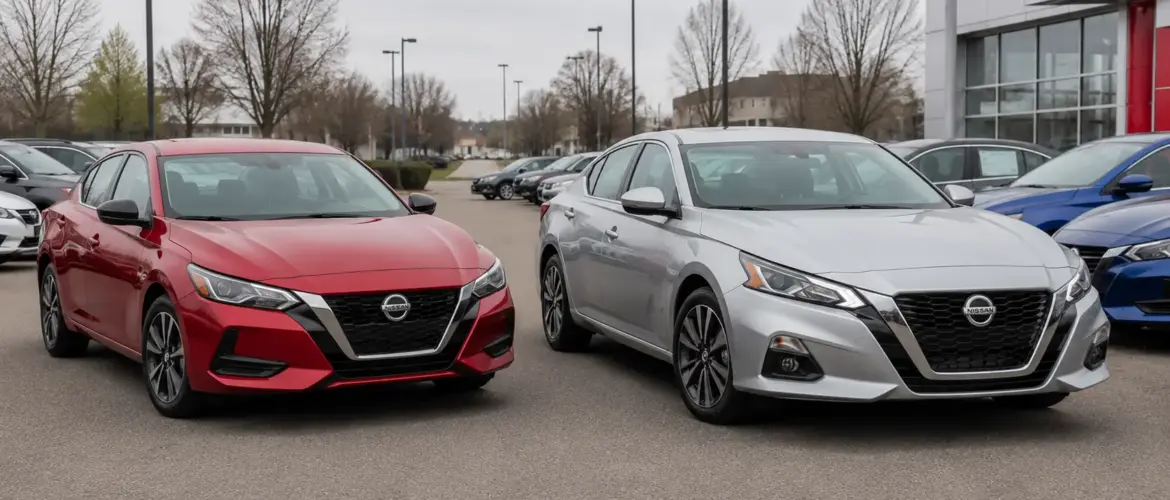
Which Nissan Sedan Is Right for You?
Here’s the fastest way to decide: if you need real winter traction, the Nissan Altima is the one — it’s the only sedan of these two that offers all-wheel drive, on every trim, for a flat $1,400. The Nissan Sentra doesn’t offer AWD at all, on any trim, at any price. That single fact settles it for a lot of Chicago-area buyers before anything else matters.
If winter grip isn’t a dealbreaker, the Sentra is the sharper buy on nearly everything else: it starts $4,980 lower than the Altima, gets up to 30 city / 38 highway mpg against the Altima’s 26/36, and — somewhat surprisingly — comes with a bigger standard touchscreen than the Altima does. The Altima answers back with a roomier cabin, 39 more horsepower, and a perfect 5-star NHTSA safety rating the Sentra hasn’t earned yet (it simply hasn’t been crash-tested). This guide breaks down price, performance, space, tech, and what both share under the hood — the CVT — so you can see which 2026 Nissan sedan actually gets you through a North Shore winter, or saves you the most money if it doesn’t need to.
Quick Comparison at a Glance
If you need AWD, the Altima wins — it’s the only one that offers it. If you don’t, the Sentra is the sharper buy: lower price, better mpg, and a 12.3-inch touchscreen standard even on the $22,600 base trim. Reliability is a wash — both rate 4.0 out of 5.0 with RepairPal.
| Category | Nissan Sentra | Nissan Altima |
|---|---|---|
| Class | Compact sedan | Midsize sedan |
| Starting MSRP | $22,600 (S) | $27,580 (SV) |
| Engine | 2.0L 4-cyl, 149 hp / 146 lb-ft | 2.5L 4-cyl, 188 hp / 180 lb-ft |
| Transmission | Xtronic CVT (all trims) | Xtronic CVT (all trims) |
| Drivetrain | FWD only | FWD standard; AWD +$1,400, every trim |
| Fuel Economy (FWD) | Up to 30 city / 38 hwy mpg | 26 city / 36 hwy mpg |
| Trunk space | 14.3 cu ft | 15.4 cu ft |
| Touchscreen | 12.3″ standard, every trim | 12.3″ available, not standard on base SV |
| NHTSA Overall | Not yet rated | 5/5 stars |
| RepairPal Reliability | 4.0/5.0 — 14th of 36 compact cars | 4.0/5.0 — 11th of 24 midsize cars |
Price and Trim Levels
The price gap is real: a loaded Sentra SL ($27,990) still comes in below where the Altima lineup starts ($27,580 SV). Part of this decision is simply whether you need what the extra money buys in size and power, or whether the Sentra already covers it for less.
Nissan Sentra Trims and Pricing
| Trim | Starting MSRP |
|---|---|
| Sentra S | from $22,600 |
| Sentra SV | from $23,370 |
| Sentra SR | from $25,000 |
| Sentra SL | from $27,990 |
Nissan Altima Trims and Pricing
| Trim | FWD | AWD |
|---|---|---|
| SV | $27,580 | $29,080 |
| SV Special Edition | $28,880 | $30,380 |
| SR | $28,980 | $30,480 |
| SR Midnight Edition | $30,980 | $32,480 |
AWD adds a flat $1,400 to the Altima, but only on the SV and SR trims — SV Special Edition and SR Midnight Edition are not available with all-wheel drive (nissanusa.com trim builder, verified July 2026). Note: the Altima no longer offers base S or top-tier SL trims — SV is now the entry point.
If the exact trim or color you want isn’t on our lot, we’ll locate your vehicle, typically within 48 hours; we can also walk you through financing options, including programs for military members and recent college grads.
Engine, Performance and Fuel Economy
This is where the two sedans diverge most clearly. The Sentra’s 2.0-liter engine — 149 hp, 146 lb-ft — is tuned for efficient commuting rather than power, and it shows in the EPA numbers: up to 30 city / 38 highway mpg, a real margin over the Altima if most of your driving is stop-and-go Chicago traffic.
The Altima’s 2.5-liter steps up to 188 hp and 180 lb-ft — a noticeable difference merging onto the Edens or passing on I-94 with a full car — but drinks more: 26 city / 36 highway mpg. Both run on regular unleaded; the Altima’s extra power doesn’t cost you at the pump in fuel grade, just in mpg.
Bottom line: the Altima’s extra power makes highway driving feel less effortful; the Sentra’s fuel-economy edge adds up more over a year of commuting than the sticker-price difference alone suggests. Neither is a performance sedan, and neither needs to be.

Interior Space, Trunk Room and Everyday Comfort
The class difference shows up here more than anywhere else. The Sentra is a compact sedan and drives like one — easy to park on tight North Side streets or squeeze into a Skokie garage, but noticeably tighter in the back seat for taller passengers. Trunk space is 14.3 cubic feet.
The Altima is a genuine midsize sedan, with more rear legroom and a cabin that feels less cramped on longer trips — a summer drive up to Wisconsin, or the whole family on weekends. Trunk space is 15.4 cubic feet.
Bottom line: the trunk gap (1.1 cubic feet) is smaller than you’d expect and isn’t the reason to choose one over the other — the back-seat and overall cabin feel matters more day to day than the extra cubic foot.
All-Wheel Drive and Winter Driving in Chicago
This is the section that actually decides the comparison for a lot of buyers, and most write-ups bury it.
Nissan Sentra. Every trim — S through SL — is front-wheel drive only, full stop. There’s no AWD option at any price. Plenty of Chicago-area drivers get through unplowed side streets in Morton Grove or Niles every winter on FWD alone with a good set of winter tires, but that’s a workaround, not a substitute.
Nissan Altima. Available with Nissan’s Intelligent AWD on every trim for a flat $1,400. It’s a front-biased, on-demand system — competent and composed in snow, not Subaru-grade trail capability, and it does nothing for braking distance on ice. Winter tires still matter more than the badge.
Bottom line: if you’re regularly driving through lake-effect snow or dealing with an unplowed street before the plows come through, that’s a real, decisive point in the Altima’s favor — the Sentra simply isn’t an option here. If you can manage on FWD with good tires, this section shouldn’t be what decides it for you.

Technology and Infotainment
This is the one place the Sentra actually leads, and it’s not close. Every 2026 Sentra trim — including the $22,600 base S — comes standard with a 12.3-inch NissanConnect touchscreen. SV, SR, and SL step up further to a 12.3-inch fully digital gauge cluster; only the base S keeps a smaller 7-inch driver display (nissanusa.com trim builder, verified July 2026).
The Altima’s touchscreen also tops out at 12.3 inches, and it’s standard on all but the base SV — SV Special Edition, SR, and SR Midnight Edition all get it standard, while the base SV keeps it as an available upgrade. Every Altima trim — SV through SR Midnight Edition — keeps a smaller 7-inch instrument cluster; there’s no larger digital gauge option at any trim level (nissanusa.com, verified July 2026).
Bottom line: for a compact car undercutting a midsize by $5,000, the Sentra’s standard tech package punches above its price. If a big driver display matters to you, don’t assume the pricier car has it — in this pair, it doesn’t.
Safety Features and Ratings
Both sedans come standard with Nissan Safety Shield 360 — automatic emergency braking, blind spot warning, lane departure warning, and rear cross-traffic alert. Neither skimps on the basics.
Where they differ is crash-test data. The 2026 Altima carries a 5-out-of-5 NHTSA overall safety rating for both FWD and AWD configurations. The 2026 Sentra hasn’t been crash-tested yet — NHTSA lists “No Overall Safety Rating” as of this writing, which reflects testing timing, not a failed or poor result (nhtsa.gov, verified July 2026).
Bottom line: the driver-assist suite is identical, so day-to-day this isn’t a strong reason to pick one over the other — but if a published crash-test score matters to your decision, that’s currently a real point for the Altima.
Reliability, Warranty and Ownership Costs
Both sedans use the same Xtronic CVT and carry identical warranty coverage — 3 years / 36,000 miles basic, 5 years / 60,000 miles powertrain. Let’s address the CVT directly, since it’s the question every Nissan sedan shopper eventually asks: the failure-prone units that gave Nissan’s CVT its reputation were built between 2007 and 2015. Nissan redesigned the transmission in 2017 and introduced an all-new CVT-X generation in 2023, recalibrated again for 2026. Separately, Nissan extended the powertrain warranty by 24 months / 24,000 miles (to 84 months / 84,000 miles total) for specific used model years covered by a 2022 class-action settlement — 2017–2018 Altima and 2018–2019 Sentra/Versa (altimasentraversacvtsettlement2022.com). That extension doesn’t apply to a new 2026 model, but it’s relevant if you’re also cross-shopping a used Sentra or Altima.
RepairPal rates both at 4.0 out of 5.0 for reliability: the Sentra ranks 14th of 36 compact cars at $491/year in average repairs; the Altima ranks 11th of 24 midsize cars at $483/year — essentially a wash (RepairPal, verified July 2026).
For maintenance on either sedan, ask about the Premium Plan, which can bundle synthetic oil changes and tire rotations with eligible purchases, or bring the car to Express Service — available for many services with no appointment needed; call ahead to confirm availability for diagnostics.
Bottom line: reliability and warranty coverage are close enough to be a non-factor. Staying current on CVT fluid service — not “lifetime fluid,” regardless of what you’ve heard — is what actually protects either transmission over time.

Which One Should You Buy?
If AWD is a real requirement for how you drive in winter, the Altima wins that argument outright — it’s the only one of these two sedans that offers it, at any price. That’s not a hedge; it’s the deciding fact, and it should lead your decision if it applies to you.
If it doesn’t — if you can manage a Chicago winter on front-wheel drive and good tires, which plenty of North Shore drivers do — the Sentra is the sharper buy almost everywhere else: lower price, better fuel economy, and surprisingly, better standard tech. The Altima’s case rests on real advantages too: more rear legroom, more power, and a 5-star NHTSA rating already in hand. Both are honest, sourced advantages — neither sedan is the obvious pick for every driver, and we’re not going to pretend otherwise just because we’re a Nissan dealership that sells both.
Choose the Nissan Sentra if…
- You want the lowest price of entry into a new Nissan sedan;
- Fuel economy for a daily Chicago commute is a top priority;
- You mostly drive solo or with one passenger and don’t need extra back-seat room;
- You want the bigger standard touchscreen without paying more.
Choose the Nissan Altima if…
- You need all-wheel drive — the Sentra doesn’t offer it at any price;
- You regularly carry rear-seat passengers who need more legroom;
- The extra 39 hp matters for highway merging and passing;
- A confirmed 5-star NHTSA safety rating matters to your decision.
FAQs About Nissan Sentra vs Altima
Do the 2026 Sentra and Altima still have the CVT everyone complains about?
How much does a Nissan CVT cost to replace, and is it covered?
Is there still a CVT warranty extension or class-action settlement I can claim?
Which is cheaper to insure?
Is the Altima’s AWD actually good in snow, or is it marketing?
Which holds its value better?
How many miles will one last?
Is Nissan discontinuing the Altima?
Drive Both, Back to Back
If you’re still torn, the best next step is driving both back to back. Stop by Old Orchard Nissan at 5240 Golf Rd in Skokie for a no-obligation extended test drive on your actual commute. If getting to Skokie isn’t convenient, ask about delivery options so you can try either sedan without the trip.


