

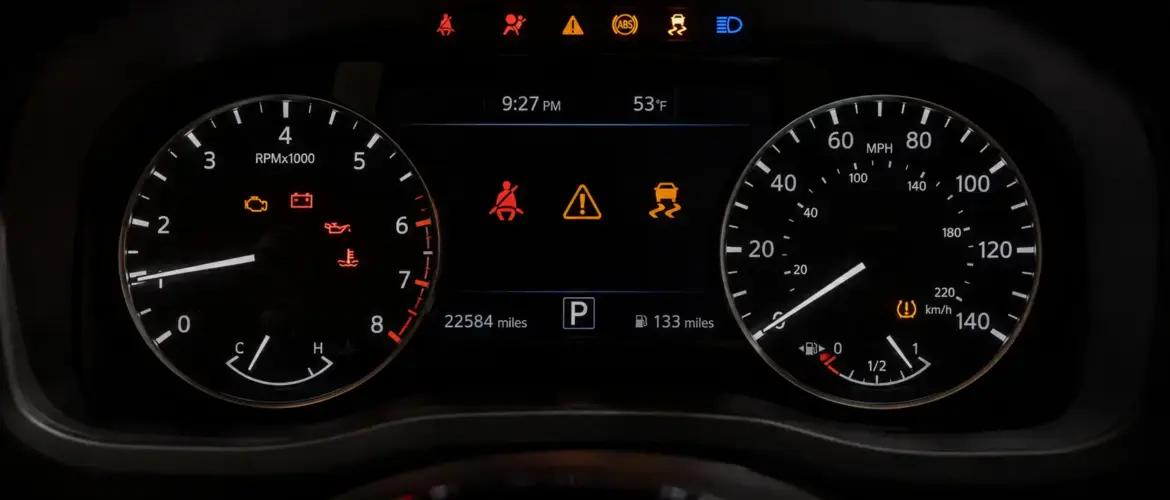
Read the Color, Not Every Icon
A dashboard light flickering on while you're merging onto the Edens isn't the moment you want to be guessing what it means. This guide covers every Nissan dashboard warning light and symbol in plain language, organized by color so you can tell at a glance whether something needs attention right now or can wait for your next service visit. It applies across the current lineup — Rogue, Altima, Kicks, Pathfinder, and the rest — and it's especially useful heading into a Chicago winter, when cold snaps are one of the most common reasons a warning light shows up in the first place.
This guide is educational, not a replacement for your owner's manual or a professional inspection. If you're ever unsure what a light means or whether it's safe to keep driving, the safer move is always to get it checked rather than guess. If you'd rather have a technician take a look than decode it yourself, our service team is a phone call away — or keep reading for the full breakdown.
What the Colors Mean
Nissan's dashboard warning lights follow a color system that's common across the auto industry, and understanding it is the fastest way to judge urgency without memorizing every single symbol:
Safety-related and urgent. Something needs attention now, and in some cases you should stop driving as soon as it's safe to do so.
A malfunction or condition that needs service soon, but usually doesn't mean you need to pull over immediately.
Informational only. These confirm a system is on or active, not that something is wrong.
Red Warning Lights: Address These Right Away
These are the lights most closely tied to safety and mechanical damage. A few of them are genuine "stop when it's safe to do so" situations.
 Urgent
Illuminates when the parking brake is engaged, or warns of low brake fluid when the parking brake is released. If it stays on with the parking brake off, treat it as urgent.
 See a Dealer
Illuminates with a chime when there's a malfunction in the electric shift control system. If the chime keeps sounding after you've switched the ignition off, make sure the parking brake is fully engaged before you walk away — Nissan specifically recommends having this checked by a dealer rather than trying to diagnose it yourself.
 Have It Checked
Normal when the parking brake is engaged. If it flashes or stays on after you've released the brake, it may indicate a system malfunction worth having checked.
 Stop When Safe
Warns of low engine oil pressure. If this comes on while driving, especially if it's flickering, pull over and shut off the engine as soon as it's safe — continuing to drive can cause serious engine damage within minutes.
 Act Now
Alerts you to keep contact with the steering wheel when using driver-assist features; if ignored, some systems will apply the brakes automatically.
 Immediate Attention
Comes on with the ignition in the ON position whenever there's an item that needs your immediate attention; the specific alert appears on your vehicle information display and stays there until you address it or turn the ignition off. Check the display for what it's actually flagging rather than guessing from the light alone.
 Buckle Up
Reminds the driver or a passenger to buckle up, with a chime. The fix is usually as simple as fastening your belt — but if it stays on after everyone's buckled, the sensor may need a look.
 Inspect Promptly
Should flash briefly at startup and turn off. If it stays on, the airbag system may not deploy properly in a crash. It doesn't affect your ability to drive right now, but get it inspected promptly.
 Don't Delay
Signals a problem with the charging system (alternator, battery, or related wiring). It won't strand you instantly, but it can leave you with a dead battery on the road.
 Stop When Safe
Indicates the engine is overheating. Like low oil pressure, this is a pull-over-and-shut-off situation; driving on an overheating engine risks serious, expensive damage.
Amber & Yellow Warning Lights: Get It Checked Soon
These generally don't require pulling over immediately, but they shouldn't be ignored for long either.
 Not a Fault
Indicates the front passenger airbag has been deliberately disabled (common with certain child-seat setups), not that something is broken.
 Service Soon
Indicates a problem with the anti-lock braking system. Your regular brakes still work, but you'll lose ABS assistance in a hard stop, so get it looked at soon.
 Check Status
Comes on when AEB is manually turned off. If it's illuminated while the system should be active, it may mean AEB is temporarily unavailable.
 Service Soon
Signals a power steering malfunction. Steering still works, but it'll feel noticeably heavier — plan to get it serviced rather than live with it.
 System Fault
Distinct from the red parking-brake light above — this one points to a system malfunction rather than the brake simply being engaged.
 Chicago Classic
Warns of low tire pressure or a fault in the tire pressure monitoring system itself. This is the light Chicago drivers see most often in the first genuinely cold snap of the year, since tire pressure drops as temperatures fall.
 Schedule Service
This is the official name for what most drivers call the "check engine light." A steady MIL usually points to an emissions-related issue, sometimes as simple as a loose gas cap — schedule service, no need to pull over. If it's flashing instead of steady, see the callout above: that's a different, urgent situation.
 Check Display
Comes on with the ignition in the ON position whenever there's an item that needs attention, with details available on your vehicle information display. If the light comes on but you don't see a message right away, use the buttons on the steering wheel to navigate the display until the "Warnings" screen appears.
 Check Status
Same idea as the AEB indicator above, for the rear automatic braking system.
 Turn It Back On
If VDC has been turned off or isn't functioning, an amber indicator will let you know your traction-control safety net isn't active — turn it back on before winter driving, not just note it and move on.
Green, Blue & White Indicator Lights: Nothing to Worry About
These confirm something is on, not that something is wrong.
 Info Only
Flash with your turn signal or hazards. If one side blinks unusually fast, it's often a sign of a burnt-out bulb rather than an electrical problem.
 Info Only
Confirms automatic high beam assist is active in AUTO mode.
 Info Only
Simply confirms your fog lights are on.
 Info Only
Confirms your headlights or side lights are on.
 Info Only
White means the system is on standby; green means it's actively holding the brakes for you at a stop.
 Info Only
On whenever your high beams are active.
What to Do When a Warning Light Comes On
Most Nissan warning lights fall into one of two buckets once you know the color system: things you can monitor and mention at your next visit, and things that call for pulling over.
- If a red oil pressure, coolant temperature, or brake warning light comes on while you're driving, get off the road safely and avoid continuing to drive the vehicle until it's inspected — those three carry real risk of expensive damage if ignored.
- If a light comes on right after a cold morning or a big temperature swing — TPMS especially — check your tire pressure before assuming something's broken. Chicago's temperature swings are a very common, very fixable cause.
- Multiple lights coming on at once, especially alongside dimming dashboard displays or slow cranking, often points to a battery or charging issue rather than several unrelated problems.
- When in doubt, our service team can run a proper diagnostic rather than you guessing from a dashboard icon alone.
Does This Differ by Nissan Model?
Not meaningfully. Whether you're driving a Rogue, Altima, Kicks, or Pathfinder, the core Nissan dashboard symbols and their meanings are standardized across the current lineup — a red oil pressure light means the same thing in a Kicks as it does in a Pathfinder. Trim level and model year can affect which lights your specific vehicle has (a base trim may not include automatic emergency braking, for example, so it won't have that indicator at all), but the icons and colors you do see follow the same system. If you drive an older Nissan or one bought outside the current generation, double-check your specific owner's manual, since icon designs occasionally change between generations.
A Local Reminder for Chicago Winters
Illinois winters are genuinely hard on a car's warning systems — cold starts strain the battery and charging system, salt and road grime can trigger sensor-related lights, and temperature swings are the single most common reason a TPMS light shows up out of nowhere. If you're seeing a light more often once the weather turns, that's not a coincidence, and it's a good reason to get ahead of it before a cold snap turns a minor issue into a stranded-in-a-parking-lot one.
Whether you need a diagnostic, genuine Nissan parts, or you're shopping for something newer altogether, our team at Old Orchard Nissan — serving Skokie, Evanston, Niles, and the rest of the North Shore — is here to help. Express Service is available for many routine maintenance items without an appointment, but a warning-light diagnostic isn't one of them — please call ahead so we can get you on the schedule and have a technician ready when you arrive.
FAQs About Nissan Dashboard Warning Lights
What does the wrench light on my Nissan mean?
It's a maintenance reminder tied to a mileage or time interval — not a warning that something is broken. It's one of the highest-volume Nissan-specific dashboard questions there is, largely because owners don't find it explained clearly in the warning-lights section of their manual (it's usually filed under maintenance instead). It won't turn off on its own; it needs to be reset through the settings menu or at your next service visit.
My check engine light is flashing — is it safe to drive?
No. A flashing check engine light means the engine is actively misfiring and sending unburned fuel into the exhaust system, which can destroy a catalytic converter within minutes. Pull over as soon as it's safe, shut the engine off, and call us rather than driving it in. A steady check engine light is a different, lower-urgency situation — see the callout near the top of this guide for the full explanation.
My SLIP and VDC OFF lights are on and won't go off.
A SLIP light that flashes briefly during driving is normal — it means traction control is doing its job on a slippery surface. SLIP and VDC OFF lights staying on together are different: that usually means the stability control system has detected a fault and disabled itself, commonly from a wheel-speed sensor issue, low brake fluid, or mismatched tires. This needs a Nissan-capable scan tool to diagnose properly — a basic $20 OBD-II reader typically can't pull the chassis-level codes involved.
TPMS light came on and it's freezing out — do I have a flat?
Probably not. Tire pressure drops roughly 1 PSI for every 10-degree drop in temperature, so a 25–30 degree overnight swing is enough to trip the light on its own. The telltale sign: it's on first thing in the morning and goes off after 20 minutes or so of driving, once the tires warm up. If it stays on regardless of temperature or driving time, that's worth an actual pressure check rather than assuming it's just the cold.
My Nissan says "Key ID Incorrect" and won't start.
The most common cause by far is a weak or dead key fob battery (typically a CR2032 coin cell). There's a workaround that gets you moving without a new battery on hand: hold the fob directly against the Start/Stop button while pressing the brake pedal, then press Start. It's a temporary fix — replace the battery when you can, since a fully dead fob will eventually stop working with this method too.
There's a red car-with-a-key symbol blinking — is my car being stolen?
No — a slow blink with the car off and the doors locked simply means the NATS immobilizer system is armed and working as designed. It's confirming your car is protected, not alerting you to a problem.
AWD warning light is on in my Rogue — can I still drive it?
It depends on the pattern, though owner reports on this vary somewhat by cause, so treat this as general guidance rather than a precise code reader. A light that stays solidly on generally points to a system fault, and the vehicle may revert to front-wheel-drive-only operation until it's diagnosed. Mismatched tire sizes or tread depth are a common, fixable trigger, since the AWD system relies on all four wheels reading the same rotational speed. Related Nissan/Infiniti platforms also use a similar warning for an overheated AWD coupling, which calls for pulling over and letting the vehicle idle in Park to cool down rather than continuing to drive. If you're not sure which situation you're in, that's a reasonable time to call rather than guess.
Can I just disconnect the battery to clear the check engine light?
You can, but it's a bad idea. It clears the stored trouble codes, but it also wipes the OBD readiness monitors your car uses to confirm a repair actually worked — and if you're due for an Illinois emissions test, too many "not ready" monitors will fail the test just as surely as an active check engine light would.
Will a check engine light fail my Illinois emissions test?
Yes — it's an automatic fail, regardless of what's actually causing it or whether the car otherwise drives fine. The Illinois EPA's vehicle emissions testing program covers the Chicago area, which includes Cook County, so this applies directly here. Clearing the code right before your test doesn't help either: the OBD system needs time and normal driving to confirm the readiness monitors are complete, and an incomplete test is treated as a fail.
How much does it cost to find out what the light means?
A professional diagnostic typically runs somewhere in the $150–$200 range depending on the issue, though many shops apply that fee toward the repair if you move forward with it. A free parts-store code scan can be a useful starting point, but it gives you a code, not a diagnosis — a single code like P0300 can point to any of several different underlying causes, and figuring out which one actually applies to your car is the harder (and more valuable) part of the job.
Not Sure What a Light Means?
A warning light is your Nissan asking for a little attention before something small becomes something expensive. Our factory-trained technicians in Skokie can run a proper diagnostic and tell you what's urgent and what can wait — no guessing from a dashboard icon.


