

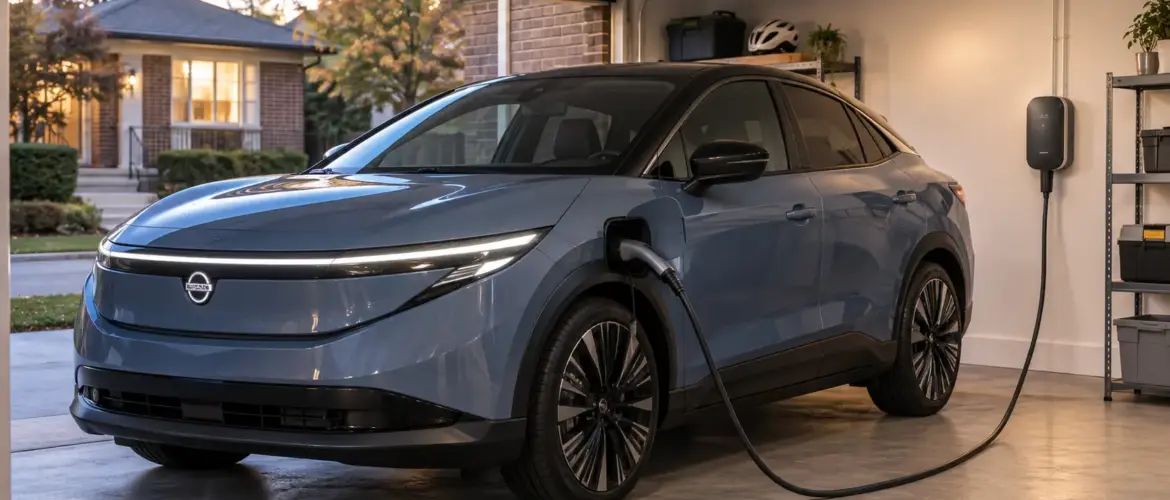
Home Charging at a Glance
Buying a Nissan LEAF and then googling “what charger do I actually need” at 11 p.m. the night before pickup is a very normal sequence of events. The answer to Nissan LEAF home charging involves two different ports on the car, two money programs that people regularly mix up, and an installation cost that depends more on your home’s electrical panel than on the charger itself.
| Charging level | Port used | Typical charging speed | Where you’d use it |
|---|---|---|---|
| Level 1 (120V) | J1772 | About 2 to 5 miles of range per hour | Backup only — not a realistic daily routine |
| Level 2 (240V) | J1772 | About 10 to 25 miles of range per hour | Home charging — what the rest of this article is about |
| DC fast charging | NACS | 10% to 80% in about 35 minutes | Public fast chargers, including Tesla Superchargers — not for home use |
Based on Nissan’s published 2026 LEAF charging information, verified October 2026. Charging speed varies with temperature, battery level, and charger output.
Two Ports, Two Jobs
The 2026 LEAF has a charging port on each front fender, and they’re not interchangeable. The J1772 port on the driver’s side is what you plug into at home and at most public Level 2 stations. The NACS port on the passenger side is for DC fast charging, including Tesla’s Supercharger network.

That means a home charger with only a Tesla-style NACS plug won’t work for overnight charging. You want a Level 2 charger with a J1772 connector. Every LEAF also includes a portable charging cable that works on a standard 120V outlet or a 240V appliance outlet, so a properly installed 240V outlet in your garage is another way to charge at Level 2 speeds.
What Installation Costs in Chicagoland
The biggest factor in what a home charging setup costs usually isn’t the charger. It’s your electrical panel. A lot of housing in Skokie, Lincolnwood, and the North Side was built with 100-amp service, and a dedicated 240V circuit can mean a panel upgrade before the electrician even gets to the charger.

If your garage is detached, as plenty are in the area’s older bungalow neighborhoods, the run from the panel to the garage adds to the job, too. Because every home is different, pricing has to be quoted for your setup — contact our service team and ask a manager for current pricing guidance before you buy a specific charger. If you plan to use the ComEd rebate, make sure your installer is on ComEd’s approved list.
Two Different Programs — Don’t Mix Them Up
This is where most of the confusion online comes from: the ComEd rebate and the Illinois EV Rebate are separate programs that cover different things.
ComEd’s rebate pays toward the charger and installation, not the car. ComEd offers up to $2,500 per household, with the highest amounts reserved for income-qualified households and homes in ComEd-designated low-income or equity communities. Other customers qualify for a smaller rebate. To qualify, you need a smart, ENERGY STAR-certified Level 2 charger installed by a ComEd-approved EV service provider, who files the application. You also need to enroll in a time-based rate, such as ComEd’s Hourly Pricing, for at least three years. That’s a real commitment, not just paperwork.
Timing matters, too. The program runs in yearly rounds with limited funding, and amounts and rules can change from one year to the next. Before you book an installer, check on ComEd’s website that applications are open and confirm the current terms.
The Illinois EV Rebate pays toward the vehicle, not the charger. It’s $2,000 toward a new or used all-electric vehicle, or $4,000 for income-qualifying applicants. A few conditions apply:
- The vehicle must be purchased, not leased, from an Illinois-licensed dealer.
- The price on the bill of sale can’t exceed $80,000, and household income limits apply.
- Each person can receive the rebate once, and you have 180 days from purchase to apply.
- The current application window runs through December 31, 2026.
What Happened to the Federal Credits
Both federal incentives that LEAF buyers used to count on are gone. The IRS New Clean Vehicle Credit ended for vehicles acquired after September 30, 2025. The federal tax credit for home charger installation ended for equipment placed in service after June 30, 2026.
Neither is LEAF-specific, and neither is something our team can work around. Right now, the ComEd and Illinois programs above are the real savings available to a LEAF buyer in this area.
Charging Through a Chicago Winter
Cold weather slows charging, not just driving range. Lithium-ion batteries accept a charge more slowly when they’re cold, which matters most at a DC fast charger and much less during an overnight Level 2 session in a garage.

That’s why the LEAF owners with the easiest winters charge at home. Pulling up to a public fast charger on a sub-zero January night after the car has sat outside all day means slower speeds than the sign promises. On the 2026 LEAF, the SV+ and Platinum+ come with a heat pump, and a battery heater is a $300 option on those two trims, both of which help in a Chicago winter.
Why Old Orchard Nissan
Old Orchard Nissan is Nissan Dealer of the Year (2019, 2023, 2024). Our team can show you both charging ports in person and talk through the home setup before you order a charger, not after you’ve bought the wrong plug.
- No-obligation extended test drives (ask your product specialist for details).
- We’ll locate your vehicle, typically within 48 hours, if the LEAF trim or color you want isn’t on our lot.
- See our current LEAF inventory.
Bottom line: the car side of LEAF home charging is simple. The part that takes planning is your panel, your installer, and timing your ComEd application for when the program is open.
Frequently Asked Questions
Can I use a Tesla charger to charge my LEAF at home?
Does the Nissan LEAF come with a charging cable?
Can I get the ComEd rebate if I already installed my charger?
Can I get the Illinois EV Rebate if I lease my LEAF?
Can I use both the ComEd rebate and the Illinois EV Rebate?
Can I install a Level 2 charger myself?
Have Questions About Charging a LEAF?
Stop by our Skokie showroom on Golf Road. We’ll show you both charging ports and talk through your home setup before you order anything.


