

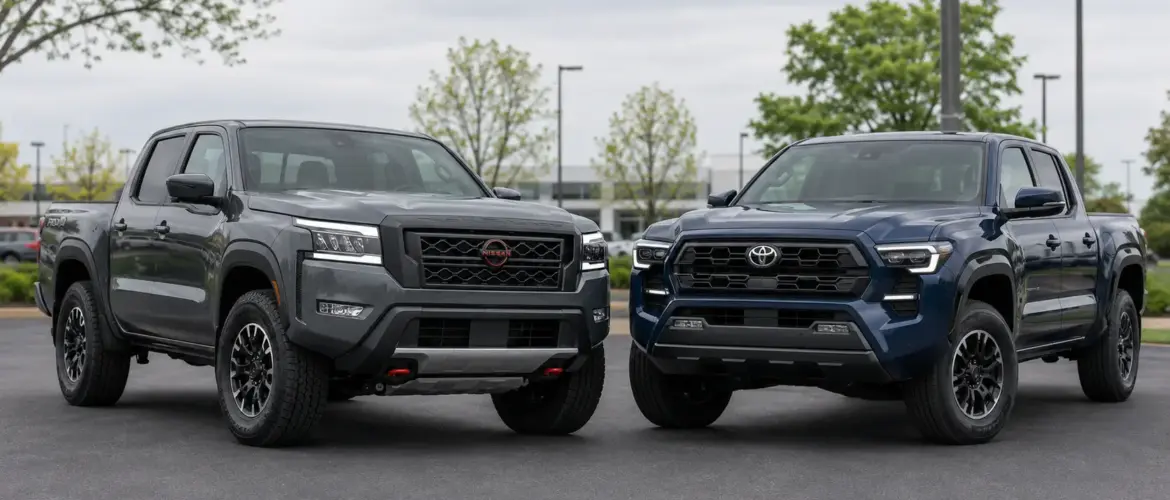
Which Midsize Truck Wins?
When you’re cross-shopping midsize pickups in the Chicago, IL area, the Nissan Frontier vs Toyota Tacoma question is usually the first one that comes up. Both trucks are built for the same mix of highway commutes, weekend trailer runs, and freeze-thaw winters that define driving across Illinois — but they go about it differently, and neither one is the better truck for every driver.
One quick disclosure: we’re a Nissan dealership, so we sell the Frontier. That’s not a reason to skip the parts where the Tacoma genuinely wins — it does, in a few real ways, and we’d rather you cross-shop with accurate information than with a sales pitch. Everything below has been checked against current manufacturer specs and independent sources as of July 2026, not just carried over from last year’s numbers.
If you already know which way you’re leaning, browse our current Nissan Frontier for sale inventory at our Nissan dealership in Skokie, IL — or keep reading below.
Quick Comparison at a Glance
Here’s a fast rundown of the core specs before we get into how each of these numbers actually plays out on the road.
| Category | Nissan Frontier | Toyota Tacoma |
|---|---|---|
| Starting MSRP | $32,150 (King Cab S 4×2) | $32,445 (Xtracab SR) |
| Engine | 3.8L V6 (all trims) | 2.4L Turbo I4 (gas or i-FORCE MAX hybrid) |
| Horsepower | 310 hp | 228–278 hp (gas, by trim/transmission), 326 hp (hybrid) |
| Torque | 281 lb-ft | 243–317 lb-ft (gas), 465 lb-ft (hybrid) |
| Transmission | 9-speed automatic | 8-speed automatic (6-speed manual on select trims) |
| Max towing | Up to ~7,150 lbs, by configuration | Up to 6,500 lbs (gas) |
| Max payload | Up to 1,590 lbs, by configuration | Up to 1,705 lbs |
| Fuel economy (EPA est.) | 19 city / 24 hwy mpg (4×2) | 18–21 city / 23–26 hwy mpg, by trim |
| Basic warranty | 3 yr / 36,000 mi | 3 yr / 36,000 mi + 2 yr / 25,000 mi complimentary maintenance (ToyotaCare) |
| Trim count | 4 grades (S, SV, PRO-X, PRO-4X) | 8 grades (SR through Trailhunter and TRD Pro) |
Price and Trim Levels
Sticker price only tells part of the story — trim structure matters just as much. The Frontier keeps things simple: four trim grades (S, SV, PRO-X, PRO-4X), one engine, and a King Cab or Crew Cab body with 5-ft or 6-ft bed options. The Tacoma spans eight trims across three different power outputs, including a hybrid, which gives you more choice but also a much wider price spread — its top trims cost more than a fully loaded, much larger full-size truck.
| Model | Starting Price (USD) |
|---|---|
| Frontier King Cab S 4×2 | from $32,150 |
| Frontier Crew Cab S 4×2 | from $33,550 |
| Frontier Crew Cab SV 4×2 | from $36,190 |
| Frontier Crew Cab PRO-4X 4×4 | from $41,870 (5-ft bed) / $42,370 (6-ft bed) |
| Tacoma Xtracab SR | from $32,445 |
| Tacoma Double Cab SR5 (4WD) | from $39,735 |
| Tacoma Double Cab TRD Off-Road | from $44,310 |
| Tacoma Double Cab Trailhunter / TRD Pro | from $65,245 to $66,245 |
All prices above exclude destination and handling fees, which run about $1,695 on the Frontier — a fairly standard figure for the segment, worth confirming on the Tacoma’s window sticker too since it varies by trim. It’s worth cross-shopping trims at similar price points rather than base-vs-base, since equipment levels don’t line up one-to-one — the cheapest Tacoma is a 2-door Xtracab work truck, while the cheapest Frontier King Cab is a 4-door.
If the exact trim, bed length, or color you want isn’t sitting on our lot, it’s worth asking — most vehicles can be located and brought in within about 48 hours, and our team can walk you through in-house financing rather than sending you elsewhere for a loan.
Engine, Performance and Fuel Economy
The powertrain philosophy is where these two trucks really diverge.
Nissan Frontier: one engine, no guesswork. Every 2026 Frontier uses the same naturally aspirated 3.8L V6 — 310 hp and 281 lb-ft, no matter which trim you choose. That simplicity is a real advantage if you don’t want to think about which engine tier unlocks which features. On the road, the V6 delivers power in a smooth, linear way that many drivers find predictable when merging or passing with a load. EPA fuel economy is 19 city / 24 highway on 4×2 models (16/20 on the 4×4 PRO-4X).
Toyota Tacoma: more power, more complexity. The Tacoma splits things up instead, and its numbers shift depending on transmission as much as trim: the base SR with the 8-speed automatic makes 228 hp and 243 lb-ft, the same SR with the 6-speed manual actually makes more — 270 hp and 310 lb-ft — and SR5 and up with the automatic land at 278 hp and 317 lb-ft. At the top, the i-FORCE MAX hybrid jumps to 326 hp and 465 lb-ft (323 hp on the Trailhunter specifically). That hybrid is genuinely the most powerful engine either truck offers, but it’s also the most expensive and mechanically complex option, which matters if long-term simplicity is part of what you’re shopping for. On the road, the turbo-four feels punchier in its higher-output trims but leans on boost to get there. Fuel economy tilts toward the Tacoma across most trims — 18 to 21 city and 23 to 26 highway.

Towing Capacity and Payload
For a lot of Illinois truck buyers, towing capacity is the deciding factor — whether that’s a boat headed to Lake Michigan from Skokie or Morton Grove, or a trailer full of landscaping equipment. The headline “max tow rating” you’ll see quoted for either truck only applies to one specific, lightest-possible configuration, so it’s worth understanding the real range rather than just the biggest number on the page.
Nissan Frontier. Towing capacity spans a fairly wide band depending on cab, bed, and drivetrain — up to roughly 7,150 lbs in its lightest configurations, down to around 6,310 lbs on a 4×4 PRO-4X Crew Cab with the long bed. Payload maxes out at 1,590 lbs, and that number drops further on PRO-4X models specifically, which are rated as low as 1,220 lbs due to their off-road suspension hardware.
Toyota Tacoma. Gas models top out at 6,500 lbs for towing — a tighter and more consistent range across trims than the Frontier’s. Payload runs the other direction on paper, though: Nissan’s own materials list up to 1,705 lbs for the Tacoma, ahead of the Frontier’s max.
On paper vs. in practice: the Frontier can out-tow the Tacoma by a solid margin in its best configuration, but that gap narrows once you’re comparing similarly equipped 4×4 crew-cab trims side by side — and if you’re planning to haul heavy gear rather than tow it, the Frontier’s lighter payload on PRO-4X models is worth knowing about before you fall in love with that trim specifically. In practice, most owners never load either truck to its absolute maximum, so the more useful question is which one tows your trailer comfortably in the exact trim you’re looking at — that’s a conversation worth having with our sales team before you assume either spec-sheet number applies to the truck on our lot.
Exterior Dimensions and Bed Size
Toyota Tacoma. Runs slightly larger overall on comparable trims — a few inches longer and wider than the Frontier — and sits noticeably higher off the ground thanks to its longer-travel suspension, especially on TRD Off-Road and Trailhunter trims. That extra ground clearance is the more useful trait once you’re off pavement.
Nissan Frontier. Its tighter overall footprint tends to be the more practical choice for parking in Chicago-area garages and tighter city lots.
Bed size. Close enough between the two not to matter much day to day — both trucks offer similarly sized short and long bed options within an inch or two of each other.
Interior Space and Comfort
In terms of cabin comfort, the numbers are close enough that personal preference and seat feel matter more than the spec sheet.
Nissan Frontier. Frequently praised for having some of the most comfortable seats in the segment — a genuine strong point after a long highway stretch. Drivers who spend more hours behind the wheel than in the back seat tend to appreciate that seat comfort most.
Toyota Tacoma. The Double Cab counters with a bit more rear legroom and a cabin that feels a step more modern in its materials and design. Families who regularly carry rear-seat passengers may lean toward that extra knee room.

Technology and Infotainment
Both trucks now offer wireless smartphone integration and large touchscreens, so neither one will feel dated.
Toyota Tacoma. Pushes further up the tech ladder with an available 14-inch display and a 12.3-inch digital gauge cluster on higher trims. If having the largest possible display is a priority, that’s a point in its favor — but it’s mostly limited to the pricier trims.
Nissan Frontier. Tops out at a 12.3-inch touchscreen. In everyday use, its NissanConnect system is straightforward and easy to learn quickly, which some drivers actually prefer over a screen with more menus to dig through.
Safety Features and Ratings
Both automakers bundle their full driver-assist suites as standard equipment, and both cover the essentials: automatic emergency braking, blind spot warning, lane departure warning, and rear cross-traffic alert.
Nissan Frontier. Comes standard with Nissan Safety Shield 360. Its 2026 IIHS results are more mixed: “Good” on small and moderate overlap front crash tests, but only “Acceptable” on side crash and headlights (varies by trim), and its vehicle-to-vehicle front crash prevention scored “Poor” — a real weak point worth knowing about rather than glossing over, along with a “Marginal” LATCH child-seat-anchor rating.
Toyota Tacoma. Comes standard with Toyota Safety Sense. Looking at IIHS’s actual 2026 category scores, the Tacoma tests well across the board — “Good” ratings in small overlap front, side crash, and both front crash prevention categories. If small-child car seats or IIHS’s specific crash-avoidance testing matter to your decision, that’s a point clearly in its favor this model year.
Reliability and Ownership Costs
This is where the Nissan Frontier vs Toyota Tacoma debate genuinely splits owners, and it depends a lot on which data source you trust — so here’s more than one, broken out by truck.
Nissan Frontier. RepairPal rates it 4.0 out of 5.0 for reliability, ranked 1st of 7 midsize trucks, with an average annual repair cost of about $470 — the best of the two on that measure. J.D. Power’s separate Quality & Reliability rating (a 100-point score based on verified owner surveys) also currently favors the Frontier, 87/100 versus the Tacoma’s 80/100.
Toyota Tacoma. RepairPal rates it lower, 3.5 out of 5.0, ranked 7th — last — of the same 7 trucks, at roughly $478 a year. But longer-established reputation studies tell a different story: it has now won J.D. Power’s U.S. Vehicle Dependability Study for midsize pickups two years running (2025 and 2026), and Consumer Reports has consistently ranked Toyota among the most reliable brands overall. It also adds ToyotaCare — 2 years or 25,000 miles of complimentary scheduled maintenance — which the Frontier doesn’t match out of the box.
Bottom line: two respected sources, two different verdicts — which is exactly why we’re showing you both rather than picking the one that flatters either truck. Both trucks carry matching basic and powertrain warranty coverage (3 years / 36,000 miles and 5 years / 60,000 miles). In practice, the reliability gap between these two has narrowed since Nissan redesigned the Frontier in 2022, and most owners of either truck report few major issues when maintenance is kept current — regardless of which truck you drive, staying ahead of the manufacturer’s service schedule at a trusted Nissan service center is what actually protects reliability over time.
Resale Value and Aftermarket Support
If you plan to trade in or sell down the road, this is worth weighing, and it’s the Tacoma’s clearest advantage.
Toyota Tacoma. Independent depreciation tracking from iSeeCars shows it holding its value noticeably better over a five-year window — about 26.3% depreciation, a gap of just over 13 percentage points better than the Frontier. That tracks with its position as the best-selling midsize truck in the country and its much larger aftermarket parts ecosystem, built up over three decades on the road.
Nissan Frontier. Depreciates roughly 39.6% over the same five-year window. That gap is real, but it’s also partly a reflection of the Frontier’s lower purchase price to begin with — the dollar difference in what you actually pay out of pocket, new versus at trade-in time, is smaller than the percentage gap alone suggests. Its aftermarket support has grown steadily since the 2022 redesign, even if it hasn’t caught up to the Tacoma’s head start.
Which One Should You Buy?
There’s no universal winner here — the right pick depends on what you’re actually going to do with the truck, whether that’s towing a boat up to the lake on weekends or handling stop-and-go commutes through Niles or Evanston all winter.
The Frontier makes more sense if…
You want the strongest towing capacity in its lightest configuration, without upgrading trims · you’d rather have one consistent V6 engine than choose between multiple four-cylinder outputs · lower day-to-day repair costs (per RepairPal) matter more to you than long-term resale percentages · you want a simpler trim lineup and a more straightforward decision at the dealership.
The Tacoma makes more sense if…
Resale value and long-term depreciation are top priorities · you want access to a hybrid powertrain for extra torque and better efficiency · a stronger IIHS crash-avoidance profile and two consecutive J.D. Power Dependability Study wins matter to your decision · you want the largest aftermarket network for accessories and off-road builds.
If you’re leaning Frontier, the best next step is getting behind the wheel. Stop by Old Orchard Nissan, the Chicago Nissan dealership at 5240 Golf Rd in Skokie, for a no-obligation extended test drive — take it on your actual commute, whether that’s into the city or out toward Glenview, and bring your notes from a Tacoma test drive if you’re still weighing both. If getting to Skokie isn’t convenient, ask about free delivery within a 10-mile radius.
FAQs About Nissan Frontier & Toyota Tacoma Comparison
Are Nissan trucks as reliable as Toyota?
Will a Nissan Frontier last as long as a Tacoma?
What are the negatives of the Nissan Frontier?
Is the Nissan Frontier or Toyota Tacoma better for towing?
Does the Nissan Frontier hold its value as well as the Toyota Tacoma?
Drive the Comparison Yourself
New Frontier in every trim, in stock in Skokie — minutes from Evanston, Niles, and Morton Grove, with free delivery within 10 miles. Bring your Tacoma notes; we’ll hand you the keys long enough to actually decide.


