

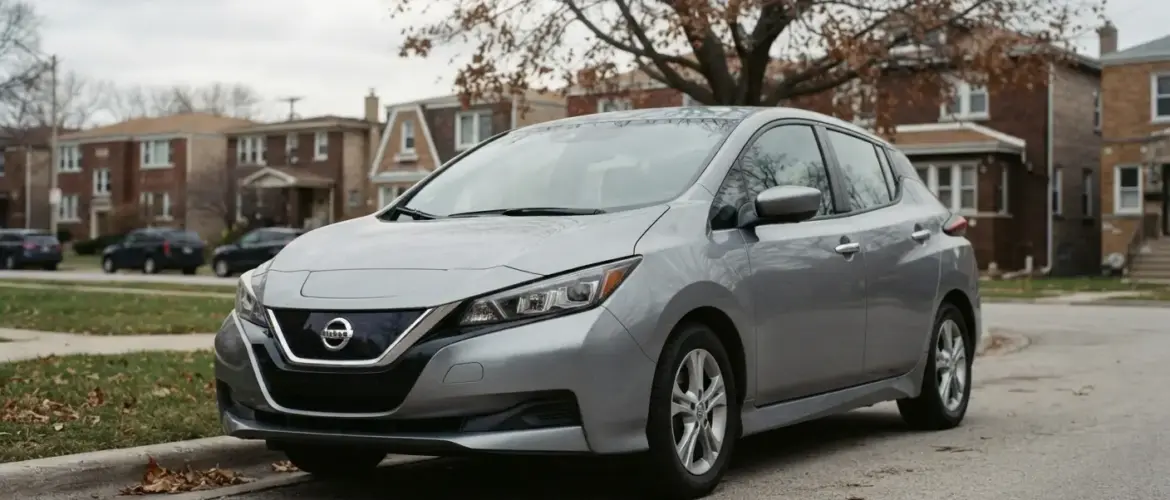
Used LEAF at a Glance
A used Nissan LEAF is one of the least expensive ways to drive electric, and also one of the easiest to buy badly. Two LEAFs of the same year can have very different batteries, and the battery is most of what you’re buying. So which years make sense, how do you read a LEAF’s battery health, and what happens if the battery needs replacing?
Three Generations, Three Different Cars
The LEAF has been on sale in the U.S. since 2011, and a “used LEAF” can mean very different things depending on the year:
| Gen 1 (2011–2017) | Gen 2 (2018–2025) | Gen 3 (2026 and newer) | |
|---|---|---|---|
| Body | Compact hatchback | Compact hatchback | Compact crossover |
| Battery | 24 kWh; 30 kWh on 2016 SV/SL and all 2017 models | 40 kWh; 62 kWh on LEAF Plus models (listed as 60 kWh from 2023) | 75 kWh (U.S. models) |
| EPA range when new | About 73 to 107 miles | About 150 miles; up to 226 miles on the Plus | Up to 303 miles |
| Battery cooling | Passive (air) | Passive (air) | Liquid-cooled |
| Charge ports | J1772; CHAdeMO fast-charge port optional on some trims | J1772; CHAdeMO optional on some trims until it became standard in 2022 | J1772 + NACS (Tesla-style) |
EPA range is the original rating for a new car. A used LEAF’s real range today depends on its battery health. Based on Nissan and EPA information, verified November 2026.
A first-generation LEAF can still work as a short-trip second car, but its range was limited even when new.
How to Check a Used LEAF’s Battery Health
Every LEAF has a battery capacity gauge on the dashboard: a row of 12 small bars, separate from the larger gauge that shows how full the battery is right now. The capacity gauge shows how much of its original capacity the battery can still hold.
- 12 bars: the battery still has most of its original capacity, but the first bar typically doesn’t drop until roughly 15 percent is gone.
- 10 to 11 bars: normal wear for a car with a few years and miles on it.
- 9 bars: noticeably reduced range; Nissan has described nine bars as about 70 percent of original capacity.
- Fewer than 9 bars: the point where Nissan’s capacity warranty can apply (see below).

The bars are a quick read, not a precise one. For the real number, ask for a battery state-of-health reading. Some owners use an OBD-II reader with an app such as LeafSpy, and as an EV Certified dealer, our service team can check a LEAF’s battery health for you.
Don’t lean on the range estimate during a test drive. It reflects how the car was driven recently, so treat it as a rough check, not a measure of the battery.
What the Battery Warranty Covers
Nissan’s lithium-ion battery warranty has two parts:
- Defects in materials or workmanship: 8 years or 100,000 miles, whichever comes first.
- Capacity loss below 9 of 12 bars: 8 years or 100,000 miles on 30 kWh first-generation cars and every second-generation LEAF. Cars with the original 24 kWh battery had 5 years or 60,000 miles, which has long since run out.
Three details matter for a used buyer:
- The clock starts at the car’s original in-service date, the day it was first delivered to a retail buyer or put into use, not the day you buy it, and the mileage counts on the odometer.
- The warranty stays with the car when it changes hands.
- A capacity claim restores the battery to at least 9 bars, not to 12. A warranty repair brings the car back above the threshold; it doesn’t make the battery new.
So a LEAF first sold in mid-2020 has battery coverage into mid-2028 or until 100,000 miles.
The Replacement-Cost Question
This is the question that stops a lot of LEAF shoppers, so here’s the honest answer: a replacement battery pack is a major repair, and on an older, out-of-warranty LEAF it can cost a large share of the car’s value. We don’t publish a single number because the cost depends on the battery size, the model year, parts availability, and labor, and it changes over time. Our service team can give you a current quote for a specific vehicle.
Two things help more than a quote:
- Price the battery health into the deal. A LEAF with 9 bars should cost noticeably less than an otherwise identical one with 12.
- Know that a new Nissan pack isn’t the only route. Remanufactured packs exist, and some owners of older LEAFs move to a larger-capacity pack. Ask us what’s available for the car you’re considering.
Why Where the LEAF Lived Matters
Heat is the main enemy of an air-cooled battery: early LEAFs in very hot places like Phoenix lost capacity much faster than the same cars in cooler climates. That makes a car’s history important. A LEAF that spent its life in the Chicago area or another northern climate has generally had an easier time than one from the desert Southwest, and the vehicle history report shows where a car was registered.
Chicago’s cold is a different story. Cold doesn’t permanently wear the battery the way heat does, but it cuts range while it lasts, often sharply on a subzero morning with the heater running. Three things help:
- Look for a heat pump. It warms the cabin using less battery than the standard heater. Many SV and SL models from 2013 on have one, but from 2018 the SV got it only with an option package, so check the build sheet.
- Charge in a garage overnight when you can.
- Warm the cabin while the car is still plugged in, so the heat comes from the grid instead of the battery.
Charging a Used LEAF Around Chicago
Most LEAF owners do most of their charging at home, from a standard outlet or a Level 2 charger. Our guide to LEAF home charging in Chicago covers the costs and the ComEd rebate. That’s easy in a house with a garage, and in Chicago, where plenty of shoppers rent or own a condo, Illinois law helps too. The Electric Vehicle Charging Act, in effect since 2024, lets renters and condo owners install charging equipment under reasonable conditions:
- Renters can install a Level 1 or Level 2 charger at their own expense, using a licensed electrician. The landlord can set reasonable conditions, such as insurance and paying for the electricity.
- Condo owners apply to their association, and an association that doesn’t answer a written request within 60 days is treated as having approved it.
Away from home, check the fast-charge port before you buy. CHAdeMO has a small public network that few new stations support, and these LEAFs can’t use Tesla Superchargers. A third-party CCS-to-CHAdeMO adapter exists, but it’s a costly workaround, not a reason to buy.

The Illinois EV Rebate Applies to Used EVs, Too
The Illinois EV Rebate isn’t only for new cars. It’s $2,000 toward a new or used all-electric vehicle, or $4,000 for income-qualifying applicants, if you buy from an Illinois-licensed dealer. The vehicle must be purchased, not leased. Three conditions trip people up: you have 180 days from the purchase date to apply, during an open application period; you have to keep the car, registered in Illinois, for at least 12 months; and funding is limited, so rebates are paid only while money remains, with income-qualifying applicants first. The current application period runs through December 31, 2026.
Why Old Orchard Nissan
Old Orchard Nissan is a Nissan Dealer of the Year (2019, 2023, 2024). Here’s how that helps when you’re shopping for a used LEAF:
- 156-point inspection on every pre-owned vehicle.
- EV Certified LEAFs. We’re a Nissan EV Certified dealer, so we can sell and support certified LEAFs, which pass a 139-point inspection and are eligible up to 6 years old with under 80,000 miles.
- Our in-house financing team works with a network of lenders, including options for bad or no credit, subject to credit approval. Explore financing.
- Trading in your current car? Get your trade-in value.
Browse our used inventory for a LEAF, or see the all-new 2026 LEAF if you’d rather start with a new battery.
Frequently Asked Questions
Does Nissan’s EV Certified warranty cover the LEAF’s battery?
What does it cost to register an EV in Illinois?
Is there still a federal tax credit for a used EV?
How do I warm up a used LEAF from my phone?
Should I check a used LEAF for recalls?
Have Questions About a Used EV?
Call us or stop by 5240 Golf Rd in Skokie. We’ll check the battery health and warranty dates on any LEAF you’re considering, and if the one you want isn’t on our lot, we’ll locate your vehicle, typically within 48 hours.


