

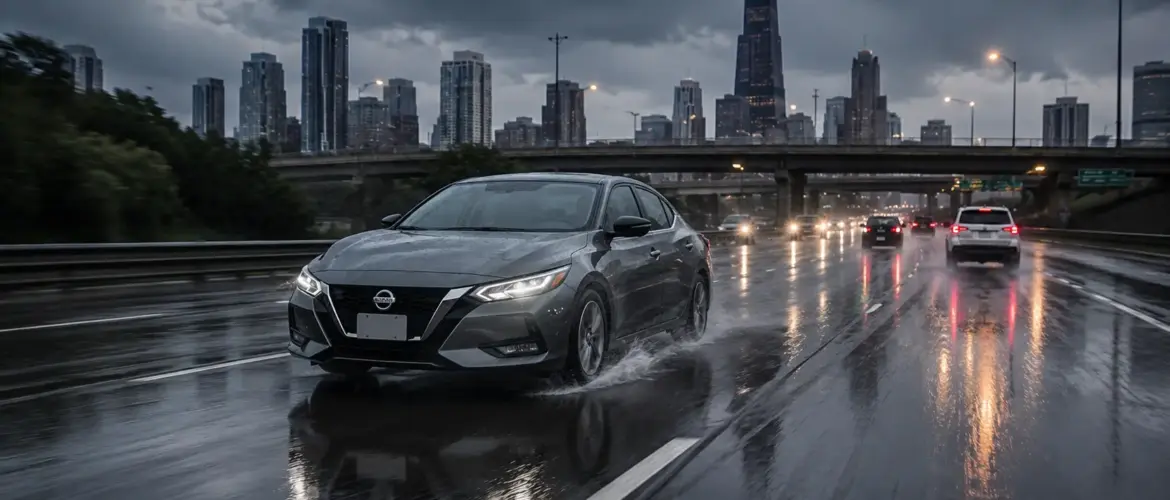
Hydroplaning at a Glance
- Hydroplaning can start around 35 mph — you don’t need highway speed or a downpour.
- Chicago drivers logged 10,580 crashes on wet pavement in 2025 — about 29 a day — but only 6,575 crashes during actual rainfall. Wet roads stay dangerous well after the sky clears.
- A wet-road crash in Chicago is roughly 14% more likely to injure someone than a dry-road crash.
- Tread depth is the one variable you control. Worn tires can’t channel water out from under the contact patch, and that’s what hydroplaning is.
- If it happens: ease off the accelerator, hold the wheel steady, don’t brake hard. Let the tires find the road again.
You’re merging onto the Edens in a downpour, doing the speed limit, nothing unusual — and for half a second the steering wheel goes strangely light and the car drifts a few inches off your line before it grips again. That’s hydroplaning, and it can happen to a careful driver doing everything right. Knowing what’s actually happening under your tires, and what to do in the two or three seconds it lasts, is the difference between a scare and a wreck.
What Is Hydroplaning, Exactly?
Hydroplaning happens when a layer of water builds up between your tires and the road faster than your tread can channel it away. Instead of gripping pavement, your tires ride on a thin film of water. Steering and braking barely respond, because they’re not actually acting on the road anymore.
The name is more literal than it sounds. “Hydroplane” originally described a racing powerboat built to skim across the surface of water instead of cutting through it. The term for tires losing grip on a wet road came later, borrowing the same idea. A tire that’s hydroplaning is doing exactly what that boat does — riding on top of the water rather than pushing through it to reach the pavement underneath.
What Causes It
This isn’t a minor hazard. The Federal Highway Administration reports that 75% of weather-related crashes happen on wet pavement, and 47% happen specifically during rainfall. Wet-pavement crashes alone account for roughly 5,700 deaths and more than 544,600 injuries a year in the US. Four things determine how likely you are to hydroplane on any given stretch of wet road:
Water Depth
Risk climbs sharply once standing water is deeper than about a tenth of an inch — thinner than it sounds, and easy to have on a road that just looks “wet.”
Speed
Hydroplaning can start at speeds as low as 35 mph, well under highway speed, if the water is deep enough and the tread is worn enough.
Tread Depth
Tires worn down to 2/32 of an inch offer almost no resistance to hydroplaning — their grooves can no longer move water out of the way fast enough.
Vehicle Weight
Lighter vehicles are more susceptible, since there’s less weight pressing the tire down through the water to the pavement.
Bottom line: you don’t need a torrential storm for this to happen. A lighter car with worn tires can hydroplane at a legal, unremarkable speed in a fairly ordinary rain.

The Most Dangerous Rain Isn’t the Heaviest
Here’s the part most drivers get backwards: it’s not the hardest rain that’s most dangerous. It’s the first rain after a dry stretch. According to NOAA, oil and grime build up on pavement during dry weather with nothing to wash them away. When rain finally comes, that residue floats to the surface and creates a genuinely slicker sheen than plain water alone. A UC Berkeley study found the danger grows with the dry spell: rain after two dry days carried about a 3.7% higher fatal-crash risk; after three dry weeks, about 9.2%.
Translation: the first 15 minutes of a summer storm after a dry week deserves more caution than the fourth hour of steady rain the next day.
What to Do the Moment You Start to Hydroplane
- Ease off the accelerator. Don’t brake hard — that can lock up wheels that have no traction to begin with and make the skid worse.
- Hold the steering wheel steady, pointed in the direction you want to go. Don’t fight it with a sharp correction.
- Wait it out. Hydroplaning typically lasts a second or two before the tires reconnect with the pavement.
- Once you feel traction return, brake gently if you need to and resume at a slower speed.
The instincts that work on dry pavement are exactly the wrong ones here:
| Instinct | Why it backfires | Correct move |
|---|---|---|
| Slam the brakes | Locks wheels that already have no grip, making the skid worse | Ease off the accelerator instead |
| Yank the wheel straight | Overcorrects once traction suddenly returns, sending you into a new skid | Hold the wheel steady, pointed where you want to go |
| Panic and speed up | Feels like regaining control; actually keeps tires riding on water longer | Let the car slow on its own until it grips again |
Why Cruise Control Is Genuinely Dangerous in the Rain
Every hydroplaning guide tells you to turn off cruise control before driving in rain, but most don’t explain why. The popular explanation — that the car “rockets forward” — is actually a myth. Fact-checkers at Snopes traced it back to a misunderstanding of what really happens.
When your drive wheels lose contact with the road, an engaged cruise control system keeps applying power to them, trying to hold your set speed. It’s not a sudden burst of acceleration. It’s that the system keeps feeding power through a skid instead of backing off the way your foot instinctively would. That difference costs you the extra half-second you need to react. Turn cruise control off before the rain starts, not after you feel the car go light.
How to Avoid Hydroplaning in the First Place
- Check your tread regularly. The classic penny test still works: insert a penny into a groove with Lincoln’s head facing down — if you can see the top of his head, it’s time for new tires.
- Keep tires properly inflated and get them rotated on a normal maintenance schedule.
- Slow down in the rain — 5 to 10 mph off your usual pace is a meaningful reduction in risk, not an overreaction.
- Add following distance. Three to four seconds becomes more like a bare minimum, not a suggestion, in wet conditions.
- Steer around standing water and avoid outer lanes, where water tends to pool deepest.
In Illinois, it’s also the law. Wipers on means headlights on — 625 ILCS 5/12-201(b) requires headlights whenever conditions call for windshield wipers.
Where Chicago-Area Drivers See This Most
Standing water isn’t a hypothetical here. Chicago logged roughly 29 wet-pavement crashes a day in 2025 — a documented pattern, not just a plausible-sounding observation. During heavy storms, underpasses on the Edens, Kennedy, Stevenson and Eisenhower expressways have flooded badly enough to shut down lanes entirely, something local news covers almost every time a serious system rolls through. It’s not only the expressways: Skokie, Evanston, Wilmette and Glenview drivers see the same standing-water spots on Golf Road, Dempster, Skokie Boulevard and Touhy Avenue during a hard rain.
If you’re driving through a low point in the road during or right after a downpour, treat visible standing water as a reason to slow down well before you reach it — not something to power through.
One more thing worth knowing: Chicago’s wettest months aren’t the ones you’d guess. May, August and June each bring more rain on average than January or February. Wet-road season here runs spring through summer, not just winter — so this isn’t seasonal advice you can file away until the next storm.
Wet Roads by the Numbers — Chicago and Illinois
Wet pavement is not a rare hazard here. In 2025, Chicago recorded 10,580 crashes on wet road surfaces — roughly 29 every day of the year. Those crashes produced 3,010 injuries and 11 deaths.
The more telling number is the comparison. Chicago logged 6,575 crashes during rainfall that same year, meaning wet-pavement crashes outnumbered rain crashes by about 60%. A road doesn’t dry the moment the rain stops, and neither does the risk. That gap is the whole reason this article exists.
Wet roads are also more likely to hurt someone: a wet-road crash in Chicago is roughly 14% more likely to injure somebody than a dry-road one.
Statewide, the picture is consistent. Illinois recorded 303,913 crashes in 2024, with 1,178 people killed and 89,023 injured. IDOT reports that 80.3% of fatal crashes happened on a dry road surface. That means about one in five fatal crashes happened on a surface that wasn’t dry.
And Chicago gets plenty of water. O’Hare averages 37.86 inches of precipitation a year. The wettest months aren’t the ones you’d guess: May (4.49”), August (4.25”) and June (4.10”) all beat January and February, which barely clear two inches.

Why Old Orchard Nissan
Checking your tread doesn’t require guesswork, and it doesn’t take long. Here’s how we make it easy at our store in Skokie:
Express Service
Pull in and we’ll measure your tread while you wait — an exact number, not a penny’s-eye estimate. Express Service is available for many services with no appointment needed; call to confirm availability.
Any Model, Too
Tire checks, rotations and replacements aren’t just for Nissans here — we service all makes and models.
Premium Plan
Our Premium Plan includes lifetime tire rotations, alongside lifetime synthetic oil changes, with eligible purchases — one of the cheapest ways to make a set of tires last.
FAQs About Hydroplaning
What does hydroplaning actually feel like?
Does braking make hydroplaning worse?
Can hydroplaning happen at low speeds, like on a residential street?
Does all-wheel drive prevent hydroplaning?
When are my tires too worn to trust in the rain?
Is a hydroplaning accident covered by insurance?
Can brand-new tires hydroplane too?
Change Your Tires on Time — at Old Orchard Nissan
The two or three seconds a hydroplane lasts are decided months earlier. That part you control, and it’s a ten-minute check.


