

Your Nissan’s VIN at a Glance
| Position | What it tells you |
|---|---|
| 1–3 | Country and manufacturer (Nissan cars start with “JN1,” “1N4,” or “5N1” — see the prefix table below) |
| 9 | Check digit — flags a typo or altered VIN |
| 10 | Model year (T = 2026) |
| Dash, door jamb, title | Must all match exactly — if they don’t, walk away |
Someone asks for your VIN — an insurance agent, the DMV, a parts counter — and you’re squinting at 17 characters on your registration that look like a randomly mashed keyboard. They’re not random. Every character in a Nissan VIN, like any VIN, is doing a specific job. Where the car was built. What it is. What year it is. A built-in check to catch typos and fraud. Once you know how to read it, a VIN stops being gibberish. It starts being genuinely useful — including for catching a used car that isn’t what it claims to be.
What Is a VIN, and Why Does It Matter?
A Vehicle Identification Number is a 17-character code, unique to your specific vehicle. It’s been standardized industry-wide since 1981. Every car, truck and SUV built for the US market has one. It’s stamped into the vehicle itself in multiple places and printed on the title, registration and insurance card.
It’s less like a serial number and more like a compact vehicle biography. Read correctly, it tells you the manufacturer, the country of assembly and the model year. It’s also enough to confirm a used car’s paperwork actually matches the car sitting in the driveway.
Breaking Down the 17 Characters
Every VIN splits into three sections, each covering a specific range of the 17 characters:
| Position | Section | What It Tells You |
|---|---|---|
| 1–3 | World Manufacturer Identifier (WMI) | Country/region of assembly, manufacturer, and vehicle type |
| 4–8 | Vehicle Descriptor Section (VDS) | Model, body style, engine, restraint system |
| 9 | Check Digit | A calculated value (0–9 or X) that flags an invalid or altered VIN |
| 10 | Model Year | The character that encodes the vehicle’s model year |
| 11 | Assembly Plant | The specific factory where the vehicle was built |
| 12–17 | Vehicle Identifier Section (VIS) | The unique serial number — roughly where it fell in the production line |
One quirk worth knowing: the letters I, O and Q never appear anywhere in a VIN. They’re too easily mistaken for the numerals 1 and 0. If a “VIN” you’re looking at contains any of those three letters, it’s not a real one.
What Your Nissan’s VIN Prefix Actually Means
This is the part most VIN guides skip. If you’re looking at your own Nissan, it’s the most useful piece of the puzzle. The first three characters tell you exactly where your specific vehicle was built.
| Prefix | Meaning |
|---|---|
| JN1 / JN3 | Japan — Nissan passenger car |
| JN6 | Japan — Nissan truck or van |
| JN8 | Japan — Nissan SUV or multi-purpose vehicle |
| 1N4 | USA — Nissan car |
| 1N6 | USA — Nissan truck |
| 5N1 | USA — Nissan SUV/multi-purpose vehicle |
| 3N1 | Mexico — Nissan car |
One caveat before you assume a single letter always means one country: outside of Nissan’s own codes, the first character alone only narrows a VIN down to a broad world region — Asia, Europe, North America. The second character, together with the first, pins down the actual country. A VIN starting with “K,” for instance, is overwhelmingly likely to be South Korea (Hyundai, Kia, Genesis). But “K” alone is assigned to a wider Asian block that technically includes a few other countries too.
Decoding the 10th Character: Your Vehicle’s Model Year
If there’s one part of the VIN people search for by itself, it’s this one. Since 1981, the 10th character has encoded the model year on a repeating cycle. It skips the letters I, O, Q, U and Z:
| Code | Year | Code | Year |
|---|---|---|---|
| Y | 2030 | P | 2023 |
| X | 2029 | N | 2022 |
| W | 2028 | M | 2021 |
| V | 2027 | L | 2020 |
| T | 2026 | K | 2019 |
| S | 2025 | J | 2018 |
| R | 2024 |
Bottom line: find the 10th character of your VIN, match it against this table, and you have your model year confirmed. No guesswork, no relying on what a seller tells you. A couple of years further out (2028–2030) are included above, since the code itself is already fixed by the standard even before those model years exist. Useful if you’re checking a VIN sample or spec sheet ahead of time.
One more thing worth knowing: this code repeats on a 30-year cycle. “A” meant 1980, and it’ll mean 2010 again. That’s why decoders also read position 7 — it’s a letter on 2010-and-newer vehicles and a number on 1980–2009 ones, which settles which trip around the cycle you’re on.

Where to Find Your VIN
You don’t need to pull the car apart to read it:
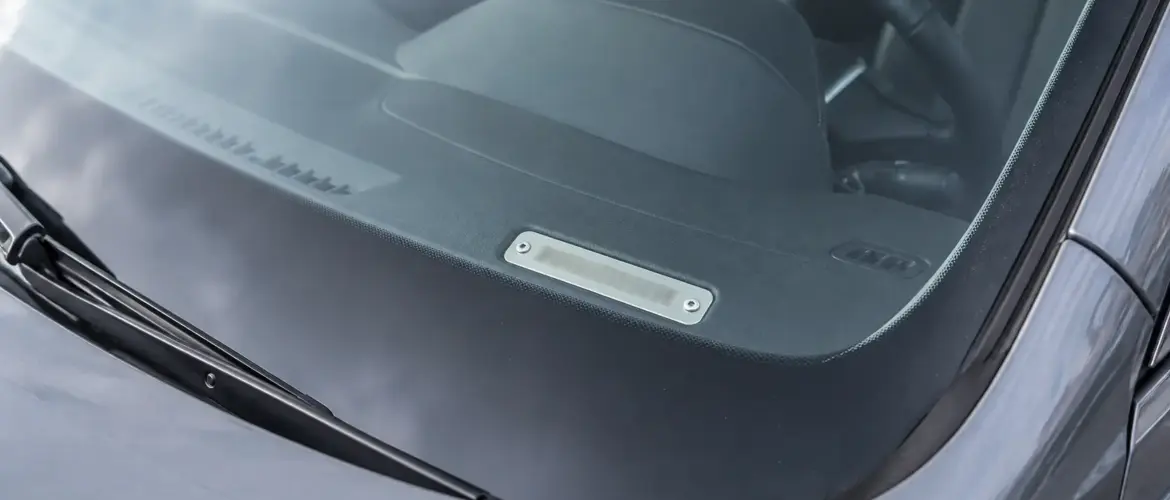
- The dashboard, visible through the base of the windshield on the driver’s side
- The driver’s-side door jamb sticker, usually near the latch
- Your title, registration and insurance card
- The engine bay, often stamped on the firewall or engine block
Why the VIN Matters Beyond Curiosity
A VIN isn’t just trivia. It’s the key to information you’d otherwise just have to take someone’s word for:
Recall Checks
NHTSA’s own VIN lookup tool (nhtsa.gov/recalls) tells you instantly whether a specific vehicle — the one in your driveway, or one you’re about to buy — has an open safety recall.
Vehicle History
A VIN is what a Carfax or AutoCheck report is actually built from — title status, reported accidents, odometer readings.
Parts and Service
The VDS and plant characters confirm exact specs, so the right part gets ordered the first time, especially on models with multiple engine or trim variations.

A Mismatched VIN Is a Red Flag
Here’s the one piece of VIN knowledge worth remembering above all the rest.
This isn’t hypothetical. The National Insurance Crime Bureau describes “VIN cloning” as a real, ongoing fraud pattern. A stolen vehicle gets a counterfeit VIN tag, copied from a legitimately registered car of the same make and model. It then gets resold with paperwork that looks clean on the surface. That’s also why federal regulation requires the VIN stamped in up to 18 locations on many vehicles — engine, transmission, hood, both front fenders and more, so investigators have somewhere else to check if the visible plate has been swapped.
It’s exactly the kind of risk a 156-point inspection is built to catch. Every pre-owned vehicle at Old Orchard Nissan goes through one before it’s ever listed, VIN verification included. You’re not the one left checking the door jamb against the title in our parking lot.
If you’re shopping elsewhere and something still feels off, NICB’s own VINCheck tool (nicb.org/vincheck) is free. It checks whether a specific VIN has been reported stolen or salvaged — a five-minute step that beats finding out the hard way.
Why Old Orchard Nissan
Every used vehicle on our lot in Skokie passes a 156-point inspection, VIN check included, before it’s ever listed. We’ve been named Nissan Dealer of the Year three times (2019, 2023, 2024). Questions about a specific Nissan’s VIN, a recall, or its build history? Reach out and our team can walk through it with you.
FAQs About Decoding a VIN
Do cars built before 1981 have 17-character VINs?
Are free online VIN decoders accurate?
Does a VIN by itself tell you if a car’s been in an accident?
What’s the difference between a VIN and a license plate number?
Can I look up my Nissan’s original factory options with the VIN?
What exactly does the check digit (9th character) catch?
Is there really a hidden VIN somewhere besides the dashboard?
Get a 156-Point-Inspected Nissan in Skokie
Every used vehicle here passes a 156-point inspection — VIN verification included — before it’s listed. No guessing where the car’s actually been.


