

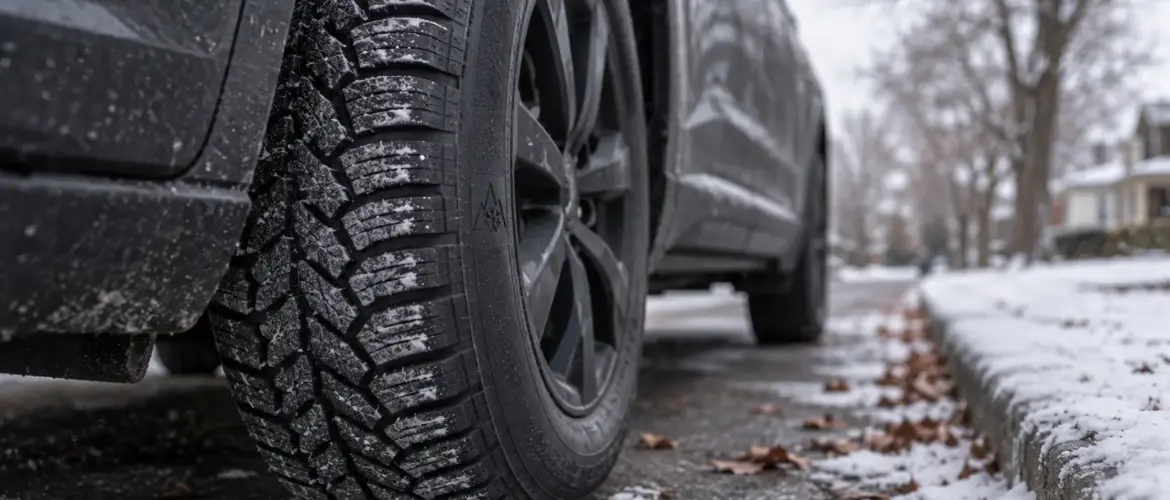
Winter Tires vs. All-Season at a Glance
Every fall, the same question comes up: do I really need winter tires, or will my all-seasons get me through? And if my Nissan has AWD, does any of this even matter? The answer to the winter tires vs. all-season question comes down to two things most people don’t think about until the first cold snap — temperature and stopping distance.
The Real Difference Is the Rubber
The biggest difference between a winter tire and an all-season tire isn’t the tread pattern you can see. It’s the rubber compound. Tire rubber stiffens as it gets colder, and stiff rubber can’t conform to the road surface the way it needs to for grip.
Continental’s head of compounding technologies, Thorsten Torbrügge, puts the threshold this way: “Below around 7°C, for example, the rubber compound of a summer tire begins to harden significantly.” That’s about 45°F. All-season tires are a compromise built to stay usable across a wide temperature range. Winter tires use a compound designed to stay flexible in the cold, which is what lets the tread bite into snow and slush instead of skating across it.

When to Make the Switch
Temperature is the trigger, not snowfall. Nissan’s own parts team puts it plainly: “It’s usually recommended you make the switch when the temperature regularly reaches below 45 degrees,” the point where the tread on standard tires becomes less flexible.
In Chicago terms, that’s usually sometime in late October or November, well before the first real snow. It also means a cold, dry 40-degree morning on the Kennedy is already outside the range where all-season tires grip their best. Booking your swap before the first cold snap beats waiting for one, when every tire shop in the area gets busy at once.

AWD Helps You Go — It Doesn’t Help You Stop
All-wheel drive sends power to all four wheels, which genuinely helps a car pull away on snow without spinning a tire. It does little for braking or cornering, because those depend on how much grip your tires have, not how many wheels are being driven. Two independent tests show the difference:
| Test | Setup | What happened |
|---|---|---|
| Consumer Reports (2015) | Front-drive Toyota Camry vs. AWD Honda CR-V, both on winter tires, braking on snow from 60 mph | Both stopped in about 300 feet — AWD gave no braking advantage |
| Tyre Reviews, reported by Motor1 (2021) | Two Mini Countryman S models: AWD on all-season tires vs. front-drive on winter tires, on snow | AWD won the acceleration tests; the front-drive car on winter tires stopped about a car length shorter and lapped the snow handling course slightly faster |
Results apply to the vehicles and conditions tested and aren’t a guarantee for any particular car.
That’s not a knock on AWD. It’s a useful system for getting moving in snow, and it’s available on Nissans like the Rogue, Kicks, and Murano. It’s just solving a different problem than stopping and turning, which is where most winter trouble starts.
What About Studded Tires?
If you’re picturing metal-studded winter tires, here’s the Illinois reality: they’re off the table for almost everyone. Under 625 ILCS 5/12-401, studded tires are allowed only for rural mail carriers employed by or under contract with the U.S. Postal Service while delivering mail, and for vehicles with disability or veterans-with-disabilities plates whose owners live in unincorporated areas on a county or township road. Both exceptions apply only from November 15 to April 1.
Tire chains of reasonable proportion are allowed when snow or ice makes them necessary for safety. For a typical Chicago-area commute, though, studless winter tires — built with cold-weather rubber but no metal studs — are the legal winter option, and they’re what most shops sell for this climate.
Swapping and Storing
If you switch to dedicated winter tires, you’ll need somewhere to keep the other set for about half the year. For a lot of Chicago-area owners, especially without a garage, that storage question is the real hassle, not the tires. Think it through before you buy a second set. Tire makers generally recommend a full set of four winter tires, regardless of drivetrain, since mismatched grip front to rear can make a car handle unpredictably.

Bottom line: the switch point that matters is a temperature, not a snowstorm, and AWD and winter tires solve different problems — buying one isn’t a substitute for the other.
Why Old Orchard Nissan
We’d rather walk you through this honestly than sell you a tire you don’t need. Our tire service team can check your current tread, talk through whether a seasonal switch makes sense for how you drive, and get you scheduled before the rush.
- Old Orchard Nissan is Nissan Dealer of the Year (2019, 2023, 2024).
- Premium Plan — lifetime synthetic oil changes and tire rotations with eligible purchases. Regular rotations help keep tread wear even on whichever set is mounted.
- We service all makes and models, so the tire conversation isn’t limited to Nissans.
Frequently Asked Questions
Is it worth switching if I mostly drive on plowed main roads?
Can I use winter tires all year to save the swap?
Do I need separate wheels for my winter tires?
Does my Nissan’s tire pressure warning come on more in winter?
Where do I store my tires when they’re not mounted?
Have Questions About Winter Tires?
Call our service team or stop by on Golf Road in Skokie. We’ll check your tread and help you plan the swap before the first cold snap.


