
What the Light Is Telling You
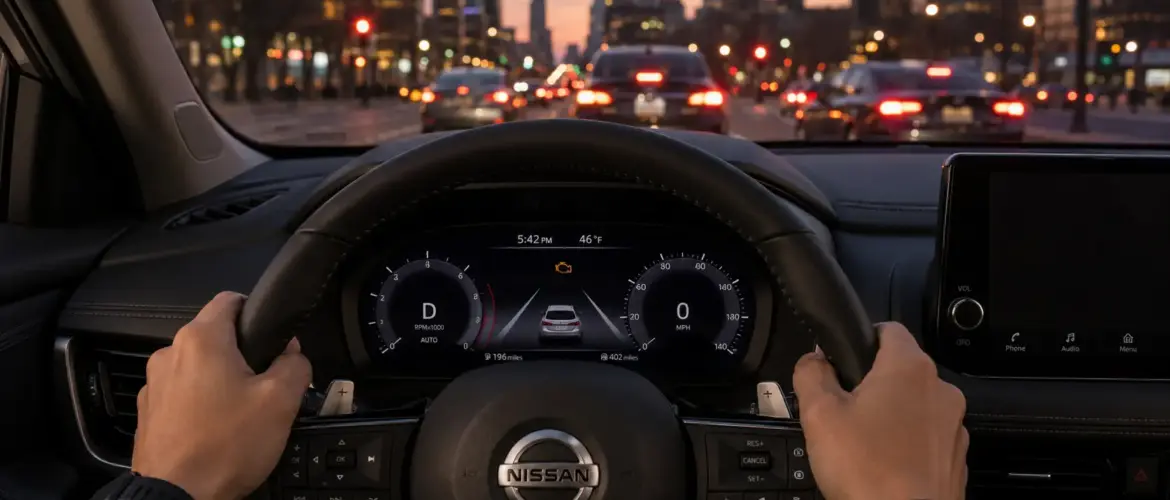
When the check engine light comes on in your Nissan Rogue, it’s natural to worry — especially when you’re in the middle of traffic on the Edens or running errands around Skokie, Evanston, or Niles. Here’s the reassuring part: most causes are minor. The light is your Rogue’s way of saying “something needs attention” — not “pull over immediately.” The key is knowing how to read what it’s telling you.
The engine computer has logged a fault that needs attention, but it isn’t an emergency. You can keep driving normally and schedule a diagnostic visit in the coming days.
A flashing light signals an active engine misfire that can dump raw fuel into the exhaust and overheat the catalytic converter, turning a modest repair into a major one. Reduce speed and load, avoid hard acceleration, and get the vehicle to a service center as soon as possible. If it’s flashing accompanied by shaking or loss of power, pull over safely and call for assistance.
8 Most Common Reasons a Rogue’s Light Comes On
A cap that isn’t clicked tight lets fuel vapors escape, and the evaporative emissions system flags it. Tighten the cap until it clicks; if the light was cap-related, it typically resets itself within a day or two of driving.
These sensors monitor exhaust oxygen so the computer can balance the fuel mixture. When one ages out, you’ll often notice slightly worse fuel economy along with the light.
Often caused by something else (misfires, bad O2 sensor) rather than the converter itself failing on its own. This is one reason not to ignore the light for months — small causes damage expensive parts.
Measures the air entering the engine. A dirty or failing MAF causes rough idle, hesitation, and poor mileage. Sometimes it just needs cleaning, especially if the air filter is overdue — something we check during the multi-point inspection that comes with every oil change.
Worn plugs or a weak coil cause misfires. Plug replacement intervals are listed in our Rogue maintenance schedule guide; staying on schedule prevents most of these.
Beyond the gas cap, small leaks in EVAP hoses and valves are common triggers — harmless to drive with short-term, but they’ll keep the light on until fixed.
Low system voltage can confuse sensors and trigger warning lights, particularly after a Chicago winter has taken its toll. A quick battery test rules this out in minutes.
We see it more than you’d think — rodents chewing harnesses (garage-kept cars near the forest preserves along the North Branch are frequent victims), or an aftermarket accessory like a remote starter interfering with a sensor circuit.
Unusual Triggers Owners Ask About
Spend time in Rogue owner forums and the same offbeat scenarios come up again and again. They’re real, and we’ve seen all of them in our service bays:
“It came on right after I got gas.”
Two usual suspects: a cap that didn’t fully click, or a tank of poor-quality fuel. A bad batch from a bargain station can trigger misfire or fuel-trim codes until it works through the tank. If it happened right after a fill-up, note the station — it helps the diagnosis.
“It came on after a car wash.”
Moisture finding its way into an electrical connector can briefly confuse a sensor. Often it dries out and the light clears in a day or two — but if it recurs after every wash, there’s a connector that needs attention before corrosion sets in.
“It came on during the first real cold snap.”
Chicago’s polar-vortex mornings are check-engine-light season. Sub-zero temps thicken fluids, drop battery voltage, and make marginal sensors fail. If your Rogue lit up the first week of January, start with a battery test — it’s the most common winter culprit.
“The light went off by itself — am I off the hook?”
The most-asked question on every forum, and the answer is no. The code stays stored in the computer even after the light clears. An intermittent fault is still a fault — it just only happens under certain conditions. Have the stored code read; it takes minutes.
“Could it be carbon buildup?”
On higher-mileage Rogues that live in stop-and-go traffic — Dempster, Touhy, the Edens at 5 p.m. — throttle-body carbon and dirty sensors are a genuine cause of rough-idle codes. A cleaning service often resolves it without replacing anything.
Steps to Take When the Light Comes On
Look at engine temperature and oil pressure warnings. If anything else is lit or the temp is climbing, pull over safely and shut the engine off.
Click it tight. If you recently fueled up, this is the most likely culprit.
Rough idle, hesitation, unusual smells, or reduced power are all worth mentioning to your service advisor — they help pinpoint the cause faster.
Disconnecting the battery or clearing the code with a cheap scanner erases the diagnostic data our technicians use to find the actual problem. The light will just come back, and the diagnosis starts from zero.
A solid light deserves a look within a few days. Schedule online in about a minute, or call (847) 965-3460 and describe what you’re seeing — we’ll tell you how soon to come in. Express Service is available for many services; call to confirm diagnostic availability.

Can You Keep Driving With the Light On?
With a solid light and no other symptoms — yes, for a reasonable period, though “it went away” doesn’t mean “it’s fixed”; the code is still stored. With a flashing light, reduced power, shaking, or strange noises — no. Continuing to drive with an active misfire is the most common way a minor repair becomes a catalytic converter replacement.
Common Check Engine Codes on Nissan Rogues
Every check engine event stores a diagnostic trouble code. These are the ones we see most often on Rogues:
| Code | What It Points To |
|---|---|
| P0420 | Catalytic converter efficiency below threshold |
| P0101 | Mass airflow sensor range/performance |
| P0300–P0304 | Engine misfire (random or by cylinder) |
| P0455 / P0442 | EVAP system leak (large / small) |
| P0335 | Crankshaft position sensor |
| P0744 | Transmission (CVT) solenoid circuit intermittent |
What Happens During a Diagnostic at Old Orchard Nissan
Our factory-trained technicians plug into your Rogue with Nissan’s own diagnostic system — the same CONSULT equipment the factory uses — read the stored codes and freeze-frame data, and then actually test the suspect components rather than replacing parts on a guess. You get a clear explanation of what’s wrong, what it costs to fix, and what can safely wait. No pressure, no mystery line items — and any repairs use Genuine Nissan Parts.
We service all makes and models, and we’re easy to reach from anywhere on the North Shore — Evanston, Niles, Morton Grove, Lincolnwood, and the north side of Chicago are all within about 15 minutes of our service center at 5240 Golf Rd in Skokie. There’s a reason this service department helped earn Old Orchard Nissan the Nissan Dealer of the Year award three times (2019, 2023, 2024) — and if you bought your Rogue here with the Premium Plan, your lifetime oil changes and tire rotations mean we’re probably catching these issues before the light ever comes on.

Frequently Asked Questions
Why is my Nissan Rogue check engine light on but the car runs fine?
Will the check engine light reset itself?
Can AutoZone-style code readers tell me what’s wrong?
Does a check engine light mean my Rogue is unsafe to drive?
Could my remote starter have caused the light?
Will winter gas or ethanol blends trigger the light?
Light On? Let’s Sort It Out
A check engine light is your Rogue asking for a little attention before something small becomes something expensive. And if you’d like to keep the light from coming on in the first place, our Rogue maintenance schedule guide lays out exactly what to do and when.