

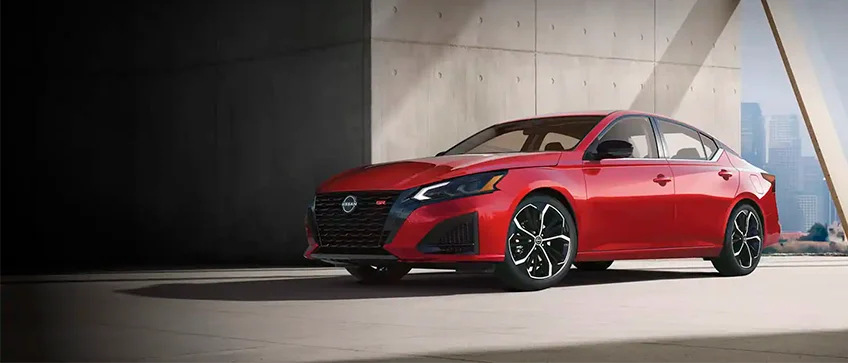
The complete Chicago-area service roadmap for Nissan’s midsize sedan. Two engine options, available AWD, VC-Turbo heat management, severe-condition CVT timing, known issues by generation, and real cost estimates.
Nissan Altima: The Essentials

Altima Service Roadmap: 5K to 100K+
Both normal and Chicago/severe intervals. CVT and transfer case milestones highlighted. VC-Turbo and AWD services noted where they differ from standard FWD.
| Miles | Normal | Chicago Severe | Services |
|---|---|---|---|
| 5,000 | 6 mo | 4–5 mo | Engine oil & filter (0W-20 synthetic), tire rotation, brake & light check, fluid top-off |
| 10,000 | 12 mo | 8–10 mo | Oil & filter, rotation, multipoint inspection, battery terminal check, tire pressure & tread |
| 15,000 | 18 mo | 12–15 mo | Cabin air filter replacement, engine air filter inspection, full brake measurement, tire balance |
| 20,000 | 24 mo | 18–20 mo | Oil, rotation, brake fluid inspection, steering & suspension check, alignment (post-pothole season) |
| 30,000 | 36 mo | 24–30 mo | CVT fluid replacement — severe (NS-3 only). Engine air filter replacement. Brake fluid change. AWD: transfer case & diff fluid. Exhaust inspection, alignment. VC-Turbo: intercooler & boost hose inspection |
| 45,000 | — | 36–42 mo | Oil, rotation, spark plug inspection, belt & hose check, cabin air filter, CVT fluid condition check |
| 60,000 | 72 mo | 48–54 mo | CVT fluid replacement — normal (severe: 2nd change). Coolant inspection. Spark plugs. AWD: transfer case & diff fluid (2nd change). Suspension check, rotor evaluation |
| 75,000 | — | — | Oil, rotation, full brake service, belt & hose inspection, cabin filter, battery load test |
| 90,000 | — | — | CVT fluid replacement (severe: 3rd change). AWD: transfer case & diff fluid. Spark plugs, coolant flush, timing chain inspection |
| 100,000+ | — | — | Struts & shocks, bushings, wheel bearings, AC system, CVT re-check, all rubber components. VC-Turbo: turbo system evaluation |
Oil: 0W-20 full synthetic (both engines). VC-Turbo: 91+ octane recommended for rated power. CVT fluid: Nissan NS-3 only. AWD models add transfer case and differential fluid. Cross-reference your owner’s manual.
Two Engines, One CVT, Different Heat Profiles
The Altima’s CVT handles more torque than the Sentra or Kicks — and the VC-Turbo pushes significantly more heat through the system. Which engine you have determines how aggressively to service.
Midsize weight + 188 hp. Between the Sentra and Rogue in load. AWD adds transfer case stress.
248 hp and 273 lb-ft through the same CVT. More torque = more heat = faster fluid degradation.
VC-Turbo: 30K. Standard 2.5L: 35K. Both on NS-3 only. Down from 60K normal.
Larger CVT unit than Sentra. A $250 fluid change prevents a $5K bill.
Why the VC-Turbo changes the equation
AWD adds transfer case service
What to watch for
Nissan Altima: What to Watch For
Two generations with different reliability profiles. The L33 (2013–2018) shared the CVT growing pains of its era. The L34 (2019+) improved significantly, but the VC-Turbo introduced its own learning curve.
Same-era CVT issues as other Nissan models. Shuddering, slipping, delayed engagement, and premature failure — typically between 60K–100K miles. Fluid degradation and overheating are the primary causes. L34 (2019+) improved significantly with revised CVT internals and better cooling.
Early VC-Turbo models experienced software-related stalling, rough idle, and throttle response issues. Nissan addressed most through ECU software updates. Later model years are smoother. Ensure TSB updates have been applied.
Some early L33 models consume oil between changes. Monitor the dipstick. Later model years and the L34 resolved this. VC-Turbo also runs clean.
Factory battery struggles by 3rd Chicago winter. The Altima’s electronics draw moderate parasitic load. Load-test from Year 3. Replacement $150–$220.
Clunking over potholes. Typically stabilizer links or strut mounts. $150–$300 fix. Chicago roads accelerate this. L34 platform is stiffer and quieter.
Occasional lane-departure or forward-collision warnings without cause. Keep sensors clean in winter. Software updates improve over time. Camera recalibration needed after windshield replacement.
Your Altima Deserves Nissan Expertise
The Altima’s dual-engine lineup demands technicians who understand both powertrains. Our team services both the standard 2.5L and the VC-Turbo — they know the thermal differences, the CVT stress profiles, and the TSB history for every model year. That’s the difference between a fluid change and a diagnostic assessment.
Nissan recognized Old Orchard Nissan in 2019, 2023, and 2024. Service quality is a core reason.
Factory-trained on both L33 and L34 — including VC-Turbo diagnostics, AWD transfer case service, and CVT-specific health checks.
Nissan NS-3 CVT fluid and transfer case fluid always in stock. VC-Turbo-specific parts and diagnostics on hand. No generic substitutes.
We service vehicles within 100 miles of Skokie. Advanced diagnostic equipment for VC-Turbo, ProPILOT recalibration, and CVT health checks.
L33 vs. L34: What Changed
A major redesign in 2019 added AWD, the VC-Turbo engine option, and significantly improved CVT reliability. Two very different ownership experiences.
L33 (Fifth Generation)
- 2.5L QR25DE — 182 hp. Reliable engine, less reliable CVT in early years
- 3.5L V6 option (discontinued after 2018) — 270 hp, more stress on CVT
- FWD only — no AWD option for this generation
- CVT issues most common in 2013–2015 models. Later L33 years improved
- Basic infotainment — smaller screen, slower processor
- Used buyers: demand CVT fluid history. V6 models ran CVT harder — extra scrutiny needed
L34 (Sixth Generation)
- 2.5L QR25DE — 188 hp (FWD) / 182 hp (AWD). Refined with better efficiency
- 2.0L VC-Turbo — 248 hp / 273 lb-ft (FWD only, SR trim). Variable compression technology
- AWD available with 2.5L — adds transfer case and differential service
- Significantly improved CVT reliability — revised internals and better cooling
- Safety Shield 360 on most trims — camera recal after windshield ($100–$200)
- VC-Turbo: early years had software issues, mostly resolved through updates by 2023+
- Stiffer platform, better insulation, modern infotainment with larger display

Four Seasons of Altima Maintenance
Seasonal demands beyond what the mileage schedule covers. AWD and VC-Turbo owners: note model-specific items.
- Battery load test
- Coolant concentration check
- Wiper blade replacement
- Tire tread evaluation
- Winter washer fluid
- Oil on severe schedule
- Tire pressure monthly
- 30–60 sec warm-up, not 10 min
- Clean ProPILOT sensors & cameras
- VC-Turbo: let turbo cool before shutdown
- Undercarriage wash
- Alignment check
- Full brake inspection
- Tire swap if winter set
- AWD: check for driveline vibration
- AC system check
- Tire pressure (heat rises PSI)
- Cabin air filter if due
- Coolant level check
- VC-Turbo: monitor oil between changes
Low-Mileage Owners: Minimum Schedule
Under 7,500 mi/year? Calendar triggers still apply. Fluids degrade on time, not just mileage — especially in the VC-Turbo’s higher-heat environment.
Even below 5K miles. Moisture and oxidation happen on a calendar. VC-Turbo oil degrades faster from heat cycling.
Brakes, tread, fluids, battery, lights, TPMS. AWD: include driveline check. VC-Turbo: include boost system.
Absorbs moisture over time. Chicago humidity accelerates this.
Loses corrosion inhibitors. Degraded coolant = risk in Chicago extremes. VC-Turbo runs hotter — coolant health matters more.
Max regardless of mileage. 5-year-old Altima with 25K miles? Still needs changing. NS-3 only.
One salt season = enough to start corrosion. Sedan clearance means more direct spray contact.

What Altima Maintenance Actually Costs
Chicago-area dealership pricing, 2025. AWD and VC-Turbo services add to FWD 2.5L baseline. Confirm NS-3 spec regardless of shop.
| Service | Cost | Frequency (Severe) | Notes |
|---|---|---|---|
| Oil & filter (0W-20) | $55–$85 | Every 3,500–5K mi | 2–3× per year. Both engines |
| Tire rotation | $25–$40 | Every 5K mi | Often free with oil change |
| Cabin air filter | $30–$55 | 12–15K mi | Easy DIY, 5 min |
| Engine air filter | $25–$50 | 15–30K mi | Also easy DIY |
| CVT fluid (NS-3) | $200–$270 | 30–35K mi (severe) | Highest-ROI service. VC-Turbo: 30K firm |
| Transfer case fluid (AWD) | $100–$150 | 30K mi (severe) | AWD (2.5L) only |
| Differential fluid (AWD) | $80–$120 | 30K mi (severe) | AWD (2.5L) only |
| Brake fluid | $80–$130 | Every 2 yr | Critical in humid climate |
| Front brake pads | $200–$320 | 25–35K mi (city) | Midsize weight = moderate wear |
| Front pads + rotors | $400–$600 | 50–60K mi | Salt accelerates rotors |
| Spark plugs | $160–$240 | 60K mi | Iridium, long life. Both engines |
| Battery | $150–$220 | 3–5 yr | Load-test from Year 3 |
| Coolant flush | $130–$190 | 90K mi / 5 yr | Nissan-spec coolant |
| Alignment | $90–$140 | Annually | Every pothole season |
| CVT replacement | $4,000–$5,500 | — | Cost of skipping fluid |
Why Documentation Protects You
Records directly affect warranty, goodwill repairs, and resale value. VC-Turbo owners: documenting that you’ve followed the correct oil spec and interval is especially important for a complex powertrain.
Nissan New Vehicle Warranty
- 3 yr / 36K — bumper-to-bumper
- 5 yr / 60K — powertrain (engine + CVT + turbo + transfer case)
- 5 yr / unlimited — corrosion
CVT, VC-Turbo, and AWD system covered under powertrain — if maintenance follows guidelines.
Goodwill Repairs
CVT fails at 65K? Nissan sometimes authorizes partial coverage. Documented service history is the #1 factor. A receipt showing NS-3 at 30K has real dollar value. VC-Turbo owners: oil change receipts showing 0W-20 at correct intervals strengthen any claim.
Resale & Trade-In
Complete dealer records add measurable value. VC-Turbo models command a premium when service history is documented — buyers want proof the complex powertrain was cared for.
What to Keep
- Every oil receipt (spec + interval)
- CVT fluid receipt with spec noted (NS-3)
- Transfer case & diff fluid receipts (AWD)
- Brake records
- TSB / recall / software update records
- Digital copies are fine
The spec on the receipt matters as much as the service itself.
Frequently Asked Questions
How often should I change the oil in Chicago?
When does the CVT fluid need changing?
Does my AWD Altima need transfer case service?
What’s different about maintaining the VC-Turbo?
Timing belt or chain?
FWD or AWD for Chicago?
Annual maintenance cost?
Can I use an independent shop?
Ready to Service Your Altima?
Factory-trained technicians. Genuine Nissan parts. NS-3 CVT fluid, VC-Turbo expertise, and AWD fluids — no substitutes. Three-time Nissan Dealer of the Year.


