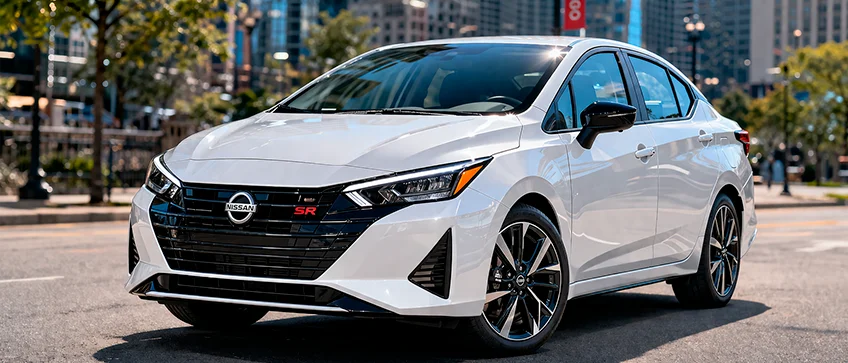

The complete Chicago-area service roadmap for Nissan’s compact sedan. Severe-condition intervals adjusted for city driving, low-clearance salt exposure, CVT fluid timing, known issues by generation, and real cost estimates.
Nissan Sentra: The Essentials
Sentra Service Roadmap: 5K to 100K+
Both normal and Chicago/severe intervals. CVT fluid milestones highlighted. Brake and undercarriage items emphasized for sedan-specific Chicago wear.
| Miles | Normal | Chicago Severe | Services |
|---|---|---|---|
| 5,000 | 6 mo | 4–5 mo | Engine oil & filter (0W-20 synthetic), tire rotation, brake & light check, fluid top-off |
| 10,000 | 12 mo | 8–10 mo | Oil & filter, rotation, multipoint inspection, battery terminal check, tire pressure & tread |
| 15,000 | 18 mo | 12–15 mo | Cabin air filter replacement, engine air filter inspection, full brake measurement, tire balance |
| 20,000 | 24 mo | 18–20 mo | Oil, rotation, brake fluid inspection, steering & suspension check, alignment (post-pothole season), undercarriage corrosion check |
| 25,000 | 30 mo | — | Oil, rotation, CVT fluid visual inspection, wiper blades, front brake pad measurement |
| 30,000 | 36 mo | 24–30 mo | Engine air filter replacement, brake fluid change, all-fluids check, exhaust & undercarriage inspection, alignment |
| 35,000 | — | 28–32 mo | CVT fluid replacement — severe (NS-3 only), cabin air filter, belt inspection, battery load test |
| 45,000 | — | — | Oil, rotation, spark plug inspection, belt & hose check, CVT fluid condition check |
| 60,000 | 72 mo | — | CVT fluid replacement — normal (severe: 2nd change near 70K), coolant inspection, suspension check, spark plugs, rotor evaluation |
| 75,000 | — | — | Oil, rotation, full brake service, belt & hose inspection, cabin filter, battery load test |
| 90,000 | — | — | Spark plugs, coolant flush, timing chain inspection, full undercarriage evaluation, all rubber components |
| 100,000+ | — | — | Struts & shocks, bushings, wheel bearings, AC system, CVT re-check, exhaust system review |
Oil: 0W-20 full synthetic (B18). B17 (2013–2019): 0W-20 also recommended. CVT fluid: Nissan NS-3 only. Cross-reference your owner’s manual.
Lighter Than the Rogue, Still Needs the Fluid
~3,050 lb curb weight + FWD = moderate CVT stress. Lighter than the Rogue, heavier than the Kicks. The Sentra sits in the middle — but city driving patterns push it harder than weight alone would suggest.
Moderate weight, FWD only. City stop-and-go adds thermal cycling beyond what the spec sheet suggests.
Nissan NS-3 only. Generic ATF = wrong friction modifiers. B17 models especially sensitive to fluid quality.
Between the Kicks (45K) and Rogue (30K). City duty and B17 heat issues justify the earlier schedule.
The price of ignoring $200 fluid changes. B17 replacements are especially common.
Why city driving matters more than weight
What to watch for
Nissan Sentra: What to Watch For
Two distinctly different generations. The B17 (2013–2019) had well-documented CVT issues. The B18 (2020+) was a ground-up redesign with dramatically improved reliability.
The most-reported B17 issue. Juddering, slipping, hesitation, and premature failure — often between 60K–90K miles. Many B17 Sentras lacked a dedicated transmission cooler, contributing to heat-related failures. Nissan issued TSBs and recalls. B18 (2020+) is dramatically improved with better cooling and revised CVT internals.
City stop-and-go eats front pads faster than mileage alone would suggest. May need pads at 20–30K miles in heavy city use. Rears last 50K+. Budget for frequent front pad replacement if you commute in stop-and-go traffic.
The Sentra’s low ride height means the undercarriage catches more road spray than a crossover. Exhaust components, brake lines, and subframe fasteners are all vulnerable. Annual spring undercarriage wash is essential — not optional.
Factory battery struggles by 3rd Chicago winter. Load-test from Year 3. Replacement $150–$200.
Older NissanConnect system was slow and prone to freezing or Bluetooth disconnects. B18 (2020+) completely redesigned — much faster and more reliable. Software updates may help B17 units.
Clunking or rattling over potholes. Typically stabilizer links or rear shock mounts. $100–$250 fix. Chicago roads accelerate wear. B18 has a stiffer, quieter platform.
Thin insulation on B17. Not mechanical — tire choice helps. B18 significantly improved sound deadening.
Your Sentra Deserves Nissan Expertise
The Sentra is one of Chicago’s most popular commuter cars — and that means city-specific wear patterns that generic shops often miss. Salt corrosion under the low body, brake pads consumed by stop-and-go, and CVT fluid degraded by short trips. Our technicians see these patterns daily and catch them early.
Nissan recognized Old Orchard Nissan in 2019, 2023, and 2024. Service quality is a core reason.
Factory-trained on both B17 and B18 generations. Know the CVT differences and TSB history inside and out.
Nissan NS-3 CVT fluid always in stock. Genuine brake pads designed for the Sentra’s weight class. No generic substitutes.
We service vehicles within 100 miles of Skokie. Advanced diagnostics for CVT health checks and TSB updates.
B17 vs. B18: What Changed
A ground-up redesign in 2020. The B18 is a fundamentally different car — larger, more powerful, better insulated, and significantly more reliable. Core CVT maintenance principles apply to both, but the details diverge.
B17 (Seventh Generation)
- 1.8L MRA8DE — 130 hp / 128 lb-ft. Adequate but not powerful
- CVT reliability was the generation’s defining weakness — especially 2013–2016
- Many models lacked a dedicated transmission cooler — heat-related failures were common
- Nissan issued TSBs and recalls for CVT-related issues
- Thin sound insulation — road and wind noise noticeable at highway speed
- Basic NissanConnect with small screen, prone to lag and Bluetooth issues
- Used buyers: demand CVT fluid history. No record past 40K = significant risk
B18 (Eighth Generation)
- 2.0L MR20DD — 149 hp / 146 lb-ft. Noticeably more refined and responsive
- Completely redesigned CVT with improved cooling — no major transmission complaints
- Safety Shield 360 standard on most trims — camera recal after windshield ($100–$200)
- Significantly better sound insulation and ride quality
- Updated infotainment — larger screen, faster processor, reliable Bluetooth
- Stiffer platform — better handling and reduced suspension noise over bumps
- Still FWD-only — same tire/winter strategy as B17

Four Seasons of Sentra Maintenance
Seasonal demands beyond what the mileage schedule covers. Low-clearance sedans take extra punishment from Chicago weather.
- Battery load test
- Coolant concentration check
- Wiper blade replacement
- Tire tread evaluation
- Winter washer fluid
- Oil on severe schedule
- Tire pressure monthly
- 30–60 sec warm-up, not 10 min
- Gentle cold-start acceleration
- Avoid deep slush — low clearance
- Undercarriage wash — critical
- Brake line & exhaust inspection
- Alignment check
- Full brake measurement
- Suspension check for clunks
- AC system check
- Tire pressure (heat rises PSI)
- Cabin air filter if due
- Coolant level check
- Road trip prep
Low-Mileage Owners: Minimum Schedule
Under 7,500 mi/year? Calendar triggers still apply. Short trips are actually harder on the Sentra’s CVT and oil than highway miles.
Even below 5K miles. Short trips = moisture buildup. The Sentra’s commuter role makes this critical.
Brakes, tread, fluids, battery, lights, TPMS. Include undercarriage check for salt damage.
Absorbs moisture over time. Chicago humidity accelerates this. City braking adds heat cycling.
Loses corrosion inhibitors. Degraded coolant = risk in Chicago’s temperature extremes.
Max regardless of mileage. 5-year-old Sentra with 30K miles? Still needs changing. NS-3 only.
One salt season + low clearance = accelerated corrosion. Brake lines and exhaust are most vulnerable.

What Sentra Maintenance Actually Costs
Chicago-area dealership pricing, 2025. The Sentra is one of the most affordable Nissans to maintain — but skipping the CVT fluid erases every dollar you saved.
| Service | Cost | Frequency (Severe) | Notes |
|---|---|---|---|
| Oil & filter (0W-20) | $55–$80 | Every 3,500–5K mi | 2–3× per year |
| Tire rotation | $25–$40 | Every 5K mi | Often free with oil change |
| Cabin air filter | $30–$50 | 12–15K mi | Easy DIY, 5 min |
| Engine air filter | $25–$45 | 15K mi | Also easy DIY |
| CVT fluid (NS-3) | $180–$240 | 35K mi (severe) | Highest-ROI service |
| Brake fluid | $80–$130 | Every 2 yr | Critical in humid climate |
| Front brake pads | $170–$270 | 20–30K mi (city) | City driving wears fronts fast |
| Front pads + rotors | $340–$480 | 50–60K mi | Salt accelerates rotors |
| Spark plugs | $140–$210 | 60K mi | Iridium, long life |
| Battery | $150–$200 | 3–5 yr | Load-test from Year 3 |
| Coolant flush | $120–$170 | 90K mi / 5 yr | Nissan-spec coolant |
| Alignment | $90–$140 | Annually | Every pothole season |
| CVT replacement | $3,500–$4,500 | — | Cost of skipping fluid |
Why Documentation Protects You
Records directly affect warranty, goodwill repairs, and resale value. B17 Sentra owners especially benefit from documented CVT service history.
Nissan New Vehicle Warranty
- 3 yr / 36K — bumper-to-bumper
- 5 yr / 60K — powertrain (engine + CVT)
- 5 yr / unlimited — corrosion
CVT covered under powertrain — if maintenance follows guidelines.
Goodwill Repairs
CVT fails at 65K? Nissan sometimes authorizes partial coverage. Documented service history is the #1 factor. A receipt showing NS-3 at 35K has real dollar value — especially for B17 models with known CVT history.
Resale & Trade-In
Complete dealer records add measurable value. The Sentra’s affordable price point means buyers are especially cost-conscious — documented maintenance signals lower risk and justifies higher resale.
What to Keep
- Every oil receipt
- CVT fluid receipt with spec noted (NS-3)
- Brake records — especially front pads
- TSB / recall work
- Undercarriage inspection notes
- Digital copies are fine
The spec on the receipt matters as much as the service itself.
Frequently Asked Questions
How often should I change the oil in Chicago?
When does the CVT fluid need changing?
Timing belt or chain?
Why do my front brakes wear out so fast?
Is the Sentra good for Chicago winters?
Should I buy a B17 or B18?
Annual maintenance cost?
Can I use an independent shop?
Ready to Service Your Sentra?
Factory-trained technicians. Genuine Nissan parts. NS-3 CVT fluid — no substitutes. Three-time Nissan Dealer of the Year.